A Complete Guide to Balanced Bellows Safety Valve
In industrial piping systems and pressure vessels, safety valves are critical devices used to prevent overpressure accidents. When system pressure exceeds the pre-set value, the safety valve automatically opens to release excess pressure, protecting equipment and personnel. However, in actual engineering applications, the outlet side of many safety valves is not directly vented to the atmosphere. Instead, it is connected to closed discharge headers, flare systems, or pipelines containing backpressure. This outlet-side pressure is known as backpressure.
Backpressure can affect the opening pressure, relieving capacity, and reseating performance of conventional spring-loaded safety valves, causing the valve to fail to operate according to its design requirements. To solve this problem, engineers developed the balanced bellows safety valve. This type of safety valve adds a bellows element to the conventional structure, effectively reducing the influence of backpressure on valve performance.
This article provides a comprehensive introduction to the working principle, primary functions, selection criteria, and operational considerations of balanced bellows safety valves, helping engineers and technical personnel better understand and properly select this important pressure relief device.
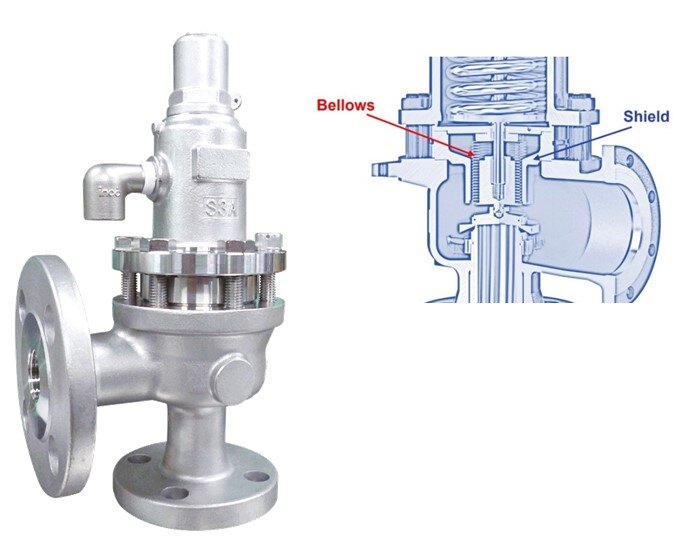
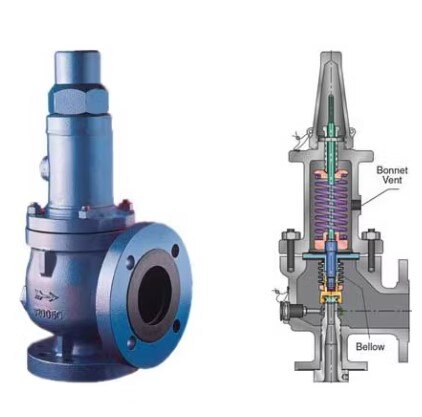
A balanced bellows safety valve is a pressure relief device that incorporates a bellows element into a conventional spring-loaded safety valve design. The bellows is installed around the valve stem or disc holder and positioned between the valve body and bonnet chamber. This bellows structure helps balance the outlet pressure acting around the disc area, allowing the valve to operate closer to its designed set pressure and expected discharge characteristics.
This type of safety valve is mainly used in applications where conventional spring-loaded safety valves may be affected by additional backpressure, built-up backpressure, common discharge headers, closed discharge systems, or varying outlet pressure conditions. The primary purpose of the balanced bellows safety valve is to reduce backpressure sensitivity, although it cannot solve every backpressure-related issue.
To understand the value of a balanced bellows safety valve, it is first necessary to understand what backpressure is and how it affects the operation of conventional spring-loaded safety valves.
Backpressure refers to the pressure existing at the outlet side of a safety valve. It is generally divided into two categories:
- Superimposed Backpressure: This is the pressure already present at the valve outlet before the valve opens. It may be constant or variable. It is commonly found in pressurized headers, closed discharge systems, or flare manifolds.
- Built-Up Backpressure: This pressure is generated after the valve opens, as fluid flows through outlet piping, elbows, silencers, and common discharge headers. The magnitude of built-up backpressure depends on factors such as relieving flow rate, pipe diameter, pipe length, and simultaneous discharge from other equipment.
In conventional spring-loaded safety valves, outlet pressure acts on internal valve areas and changes the force balance around the valve disc. Backpressure can affect valve performance in several ways:
- Opening Pressure Changes: Backpressure acts on the disc and internal components, altering the force balance required for valve opening. Even if the valve passes factory set-pressure testing, the actual opening pressure after installation may deviate from the set value because of site backpressure conditions.
- Reduced Lift and Relieving Capacity: During discharge, backpressure can affect valve lift, preventing the valve from fully opening and reducing relieving capacity.
- Poor Reseating Performance: Backpressure can influence blowdown and resealing performance, potentially causing poor reseating or incomplete closure.
- Chatter and Instability: Fluctuating backpressure may cause valve chatter or oscillation, which can eventually damage the valve seat.
After understanding the problems caused by backpressure, the next step is to examine how balanced bellows safety valves solve these issues through structural design. The operating process, balancing mechanism of the bellows, and cold differential test pressure adjustment together form the core of this technology.
The operating process of a balanced bellows safety valve is similar to that of a conventional spring-loaded safety valve.
Under normal operating conditions, system pressure remains below the set pressure, and the spring keeps the valve disc tightly seated against the nozzle to maintain sealing. When inlet pressure reaches the set pressure, the valve begins to open. During relieving operation, the bellows reduces the influence of outlet backpressure on the force balance around the disc, allowing the valve to maintain relatively stable performance during discharge.
When system pressure decreases, the valve must reseat properly. Reseating performance is closely related to spring force, blowdown, guide component condition, seat condition, outlet piping stability, and backpressure variations.
The bellows acts as a flexible sealing barrier positioned between the process medium and the internal valve components. Its main function is to isolate the valve spring and upper bonnet chamber from backpressure effects.
When the pressure beneath the valve disc rises above spring tension, the valve begins to lift open, and the bellows expands simultaneously to maintain pressure balance.
This compensation occurs in both radial and axial directions because the effective area of the bellows is equal to or greater than the sealing area between the disc and nozzle. By compensating for backpressure and protecting internal components from corrosive process media, the bellows improves the accuracy and reliability of the safety valve.
For applications involving constant superimposed backpressure, if the medium is clean, non-viscous, non-corrosive, and free from crystallization or polymerization tendencies, users may choose a conventional safety valve. The user must provide the backpressure value to the manufacturer, who will apply a Cold Differential Test Pressure (CDTP) adjustment by subtracting the constant superimposed backpressure from the set pressure. This ensures that the valve opens at the required pressure under actual operating conditions.
For applications involving variable superimposed backpressure, users must select a balanced bellows safety valve. After considering CDTP adjustments to compensate for the influence of operating temperature on spring mechanical properties, the opening pressure under actual field conditions will remain consistent with the test bench value.
The reason balanced bellows safety valves can operate reliably under complex service conditions lies in the multiple functions provided by the bellows element.
The bellows effectively neutralizes the impact of backpressure on valve operation, ensuring stable and consistent valve performance. By isolating the area above the disc from outlet backpressure, the bellows prevents additional forces from altering the set pressure. This isolation design enables the valve to operate accurately and provide reliable overpressure protection.
The bellows isolates the process medium from internal components, reducing corrosion damage to the spring and other critical parts and extending valve service life.
For special media applications, the presence of the bellows also allows components above the bellows, such as the bonnet, stem, spring, spring support, spring adjustment screw, lock nut, and cap, to be manufactured from less corrosion-resistant but lower-cost materials, reducing both valve and system costs.
Under highly corrosive service conditions, such as hydrogen sulfide environments, the bellows must be manufactured from Inconel® 625 material according to NACE MR0175 requirements.
In some applications, the process medium may be corrosive, highly viscous, prone to crystallization, or susceptible to polymerization. If these media enter the clearance between the guide bore and disc holder shaft in a conventional safety valve, the gap may become filled and cause valve failure.
Balanced bellows safety valves use the bellows as an isolation barrier to prevent such media from entering critical moving parts.
Even when the backpressure condition is constant superimposed backpressure, balanced bellows safety valves are still recommended if the medium is dirty, corrosive, contains suspended solids, tends to crystallize or polymerize, or has very high viscosity.
For larger safety valves, such as Q, R, and T nozzle series, when the set pressure is below 3.0 barg (43.5 psig), bellows construction is recommended even if no variable backpressure exists and the medium is clean.
This is because the bellows improves disc reseating performance during discharge, making the reseating process smoother and allowing the valve to reseal more effectively compared to conventional safety valves under the same conditions.
After understanding the functions of the bellows, engineers must evaluate a series of critical technical parameters during valve selection.
Because the bellows occupies internal valve space, balanced bellows safety valves under backpressure conditions experience reduced flow capacity and increased fluid velocity. To compensate for this loss, correction factors such as Kw and Kb must be applied for liquid and gas service conditions.
The final calculated minimum nozzle area is usually larger than that required for valves without backpressure or without bellows.
According to API Std. 526, the allowable backpressure limit for balanced safety valves is generally lower than that for conventional designs because of the presence of the bellows.
When operating temperatures exceed 100°F (38°C), allowable pressure limits may decrease further. Therefore, valve manufacturers should be consulted for higher-temperature or higher-backpressure applications.
Bellows materials must be compatible with the process medium. In high-temperature, corrosive, vibrating, or frequently cycling applications, bellows material selection directly affects valve reliability.
The material should be selected according to medium characteristics, temperature, pressure, and operating conditions.
Every balanced bellows safety valve must include an open vent hole on the bonnet. The main purpose of this vent is to maintain bonnet internal pressure equal to atmospheric pressure, preventing pressure from acting on an area larger than the nozzle sealing area and avoiding additional downward force on the disc.
The vent hole also prevents bellows rupture caused by reduced air volume and increased pressure inside the bonnet during valve operation.
In addition, this vent is known as a sentinel hole and is used to monitor bellows integrity.
In corrosive environments, the vent must be piped to a safe location to prevent sticking between the disc holder and guide sleeve or between the stem and spring adjustment screw. For toxic or flammable media, the vent must likewise be routed to a safe area.
It is essential to confirm that the bellows material can withstand the corrosiveness, temperature, and other characteristics of the process medium. Special attention is required for media prone to crystallization, polymerization, or high viscosity.
Balanced bellows safety valves cannot eliminate backpressure within the discharge system. Therefore, common headers, flare systems, silencers, and outlet piping still require complete evaluation.
Outlet piping design must fully consider the impact of backpressure on valve performance.
Balanced bellows safety valves require regular inspection and maintenance. Sufficient maintenance space must therefore be considered during installation.
Relevant maintenance documentation should also be prepared, including valve technical datasheets, maintenance manuals, and test reports.
Although balanced bellows safety valves offer many advantages, they are not universal solutions.
The bellows is continuously subjected to movement, temperature, pressure, and operating conditions, making it a critical pressure-relieving component. Cracking, corrosion, or improper installation may cause the bellows to lose its balancing function.
If the bellows fails, the valve may lose its balanced characteristics, and the influence of backpressure will increase significantly. Process media may also enter unintended areas, causing leakage, internal bonnet corrosion, unstable opening, or abnormal reseating. This may require shutdown, disassembly, repair, retesting, and updating of technical documentation.
Because the spring rate of the bellows itself limits the achievement of lower set pressures, the minimum set pressure of balanced safety valves is usually higher than that of conventional safety valves, typically around 1 barg (15 psig).
Both conventional and balanced safety valves also have maximum set pressure limitations, and allowable values decrease as nozzle area and set pressure increase.
Balanced bellows safety valves cannot solve every backpressure issue. Even with balanced bellows construction, poor reseating may still occur if the valve is oversized, guide components become contaminated, or the seat has already been damaged by chatter.
In actual engineering practice, balanced bellows safety valves should not be assumed to maintain perfect balancing performance throughout their entire service life. Bellows integrity, bonnet venting conditions, and service compatibility must all be included in regular inspection and maintenance programs.
Although bellows provide significant advantages, they may eventually wear out or fail during long-term operation. Regular inspection and maintenance are therefore extremely important to ensure bellows integrity.
To detect problems early, bellows leak detection systems have also been developed to monitor bellows condition and quickly identify failures.
A balanced bellows safety valve is a pressure relief device designed to reduce sensitivity to backpressure through the use of a bellows element. Its core functions include backpressure compensation, corrosion protection, and prevention of process media contamination of internal components.
This type of safety valve is especially suitable for applications involving variable superimposed backpressure, high built-up backpressure, corrosive media, or highly viscous fluids.
During valve selection, engineers must carefully evaluate relieving capacity, certified capacity, manufacturer-allowable backpressure, bellows material, bonnet venting conditions, medium compatibility, outlet piping design, maintenance space, and maintenance documentation.
At the same time, it is important to recognize that balanced bellows safety valves cannot solve all backpressure problems, and the bellows itself may fail over time. Therefore, bellows integrity inspection must be included in regular maintenance programs. Proper selection, installation, and maintenance of balanced bellows safety valves can ensure reliable overpressure protection under complex operating conditions and help maintain the safe operation of equipment and systems.