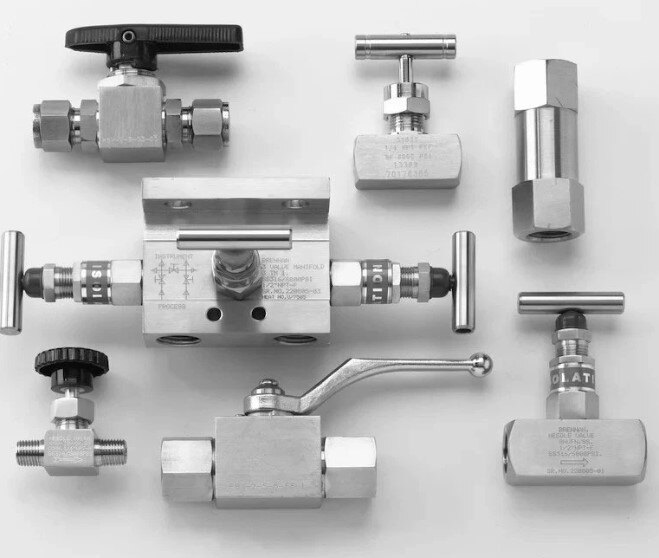
Although needle valves are usually small in size, they play an extremely important role in industrial fluid control systems. In industries such as oil and gas, chemical processing, power generation, pharmaceuticals, instrumentation, and laboratory analysis, many systems require stable, accurate, and safe regulation of small flow rates. Needle valves are one of the key components used to achieve this objective.
Compared with ordinary valves, needle valves provide finer flow control, more reliable sealing performance, and higher adjustment stability. For this reason, they are widely used in high-pressure, low-flow, and high-precision control applications. However, there are many types of needle valves available on the market, and there are significant differences in structure, materials, pressure ratings, and manifold configurations. Improper valve selection may not only affect system control accuracy, but may also lead to leakage, wear, or even safety risks.
This article systematically introduces the basic principles, major types, selection methods, typical applications, and manifold configurations of needle valves. The goal is to help users fully understand the characteristics and application logic of needle valves so they can select more reliable and suitable solutions for practical engineering projects.
A needle valve is a special type of globe valve mainly used to control the flow rate of fluid passing through the valve. It consists of a long tapered needle-shaped plug and a matching tapered seat. By rotating the valve stem, the needle plug gradually moves into or out of the seat, allowing the flow passage to open or close slowly. This design enables the needle valve to provide precise flow regulation.
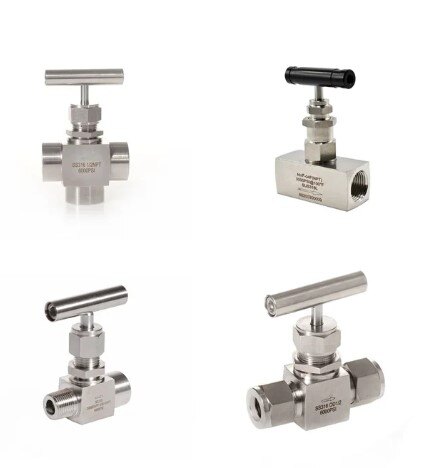
The working principle of a needle valve relies on the gradual contact between the needle plug and the valve seat. The valve stem is equipped with precision threads connected to the tapered needle plug. When the operator rotates the handle, the needle plug moves up or down inside the seat, precisely controlling the flow area.
Because of the tapered design of the needle plug, the flow change is nearly linear. Unlike ball valves that provide quick opening and closing, needle valves regulate flow through gradual opening and closing of the flow path, allowing much finer control. For this reason, they are especially suitable for low-flow applications. This gradual adjustment method can also reduce pressure fluctuations in the pipeline.
Needle valves have several important characteristics:
High control accuracy. The precision thread design allows users to make highly accurate flow adjustments.
Excellent sealing performance. The close fit between the needle plug and seat provides reliable shutoff capability.
Strong durability. Needle valves manufactured from high-quality materials can withstand harsh operating conditions.
These features make needle valves indispensable in applications requiring precise flow control.
After understanding the basic concept of needle valves, it becomes clear that there are many different types available on the market. To better understand them, needle valves can be classified according to operation method, structural design, manufacturing material, and functional characteristics.
With so many types of needle valves available, choosing the most suitable one for a specific system requires a systematic selection process. The process usually begins with understanding application requirements, followed by evaluating material, size, pressure rating, and temperature rating.
The first step in selecting a needle valve is understanding the application requirements.
Important questions include:
Different media require different valve materials. A valve designed for water service may not be suitable for highly corrosive chemicals. Similarly, a valve with a low pressure rating may not perform safely in high-pressure applications.
By answering these questions, users can identify the most suitable type of needle valve for their application and ensure system safety.
Material selection is one of the most important factors in needle valve selection. The chosen material must be compatible with the process fluid, operating temperature, and corrosion requirements.
Stainless steel 316 is the standard material for most process industry applications because it combines corrosion resistance with good mechanical strength.
Brass is an economical and practical choice for general water service or low-pressure applications.
Plastic or special alloys are more suitable for highly corrosive media.
Improper material selection may lead to premature valve failure or even safety accidents.
The valve size should match the required flow rate.
An undersized valve may reduce system performance, causing insufficient flow or excessive pressure drop.
An oversized valve may reduce control accuracy and increase unnecessary costs.
The valve flow capacity must satisfy actual system requirements. In instrumentation systems used in process industries, needle valves are often used in sampling systems, pressure gauge connections, and calibration devices, where flow control accuracy is extremely important.
Pressure rating is one of the key factors in needle valve selection. The valve must withstand the maximum pressure within the system; otherwise, safety problems may occur.
High-pressure needle valves are available with ratings ranging from standard industrial pressure levels up to 690 bar. When selecting pressure ratings, users should consider not only normal operating pressure but also pressure fluctuations, temperature effects, and safety factors.
The valve pressure rating should exceed the maximum system working pressure, usually with a safety margin of 1.5 to 2 times.
Temperature rating is equally important. The valve must operate safely at the maximum working temperature of the application without damage.
Stainless steel needle valves are suitable for high-temperature environments.
Plastic needle valves may deform or fail at elevated temperatures.
Users must ensure that the material temperature range matches the actual operating conditions.
After understanding the key selection parameters, it is useful to examine how needle valves are applied in different industries. Different industries focus on different performance requirements, and understanding these applications can help confirm whether a valve selection is appropriate.
In the oil and gas industry, needle valves are used for pressure and flow control in drilling and pipeline systems. Because these applications often involve high pressure and corrosive media, high-pressure needle valves made from stainless steel or alloy steel are commonly selected.
Offshore oil platforms require extremely reliable equipment. Forged body needle valves are widely used because of their high strength and durability.
The chemical industry requires precise fluid regulation in reactors and distillation columns. The fine control provided by needle valves helps maintain process efficiency and product quality.
In the pharmaceutical industry, needle valves are used for precise chemical dosing and mixing to ensure production consistency and safety.
These industries typically use corrosion-resistant stainless steel needle valves, while Hastelloy or Inconel valves may be used in highly corrosive environments.
Water treatment plants use needle valves to control the flow of water treatment chemicals and ensure stable treatment performance.
In HVAC systems, needle valves help maintain flow rates in air conditioning and refrigeration equipment, improving system efficiency.
These applications usually operate at relatively low pressure, so brass or stainless steel needle valves are often sufficient.
Fuel injection systems and hydraulic braking systems in the automotive industry require accurate flow control, making needle valves essential components.
In the aerospace industry, needle valves regulate fuel flow and hydraulic pressure. Because of strict space and weight limitations, miniature needle valves are widely used.
Applications in mobile equipment require compact structures, lightweight design, and high reliability.
Laboratory gas distribution systems and dialysis equipment in medical facilities require accurate control of gas and liquid flow. Miniature needle valves are ideal because of their compact structure and high control precision.
Gas flow control systems in laboratory analytical instruments and research facilities often use multi-turn needle valves for slow and precise adjustment.
These applications have very strict cleanliness and accuracy requirements, so stainless steel is usually the preferred material.
In instrumentation systems and complex piping arrangements, needle valves are often integrated into manifold assemblies rather than used individually. Manifold configuration directly affects system safety, maintenance convenience, and space utilization.
The two most common manifold configurations are integral manifolds and block-and-bleed manifolds.
Integral manifolds combine multiple needle valves into a single machined valve body. This compact design minimizes leakage points because all flow passages are machined within one body.
Integral manifolds are suitable for applications with limited installation space and where minimizing external connections is important. Because fewer external fittings are used, maintenance is relatively simple. They are ideal for applications where compactness and minimum leakage are priorities.
Block-and-bleed manifolds consist of separate valves connected through internal passages, including independent isolation valves and bleed valves.
This configuration allows technicians to safely isolate instruments and release residual pressure before maintenance, ensuring safe instrument removal and calibration in pressurized systems.
Block-and-bleed systems provide both isolation and pressure release functions, making them essential for safe maintenance and calibration procedures.
The choice of manifold configuration depends on safety requirements, maintenance procedures, and space limitations.
Block-and-bleed systems are suitable for applications requiring regular instrument maintenance because technicians can safely isolate and depressurize the system.
Integral manifolds are better suited for applications where compact design and minimal leakage points are priorities.
In industrial environments such as oil, gas, and chemical plants, even small flow variations can affect process efficiency or safety standards. Therefore, manifold configuration should be selected carefully.
When purchasing needle valves, the following steps are recommended:
Clearly define application requirements and system conditions, including medium type, operating pressure, operating temperature, and environmental conditions.
Select suitable materials according to the application, considering corrosion resistance, mechanical strength, and cost.
Ensure that the valve flow capacity matches actual system requirements and choose the proper valve size.
Confirm that the valve pressure and temperature ratings include sufficient safety margins.
Consider the valve price and choose products that meet performance requirements within the project budget.
As a key component in fluid control systems, the selection of a needle valve directly affects system safety, reliability, and economic performance. By understanding needle valve types, materials, configurations, and selection principles, users can choose the most suitable solution for specific applications and ensure the long-term stable operation of industrial systems.