Guide to Manifold Valves: Design, Operation & Applications
In industrial operations, fluid control is a critical factor in ensuring safe and stable system performance. Faced with complex piping networks and diverse control requirements, engineers need solutions that not only simplify piping layouts but also guarantee reliable sealing. The manifold valve is an essential device developed to meet these needs.
This article provides a comprehensive overview of manifold valves, covering their fundamental concepts, types, structural design, material selection, and applications across industries. It aims to help readers gain a thorough understanding of this key component in fluid control systems.
A manifold valve is a precision device that integrates multiple valve functions into a single compact body. Its primary role is to perform functions such as isolation, regulation, venting, draining, and pressure equalization in fluid and gas systems.
Unlike traditional setups where multiple valves are installed separately, manifold valves use a modular design to combine several functions that would otherwise require multiple independent valves.
In industrial instrumentation and process control systems, manifold valves are typically used in conjunction with pressure gauges, transmitters, and differential pressure sensors. They act as the interface between the process system and measurement instruments. This allows operators to monitor process parameters while also enabling safe isolation of instruments from the process when necessary.
This integrated design reduces the number of connection points in piping systems and significantly lowers the risk of leakage.
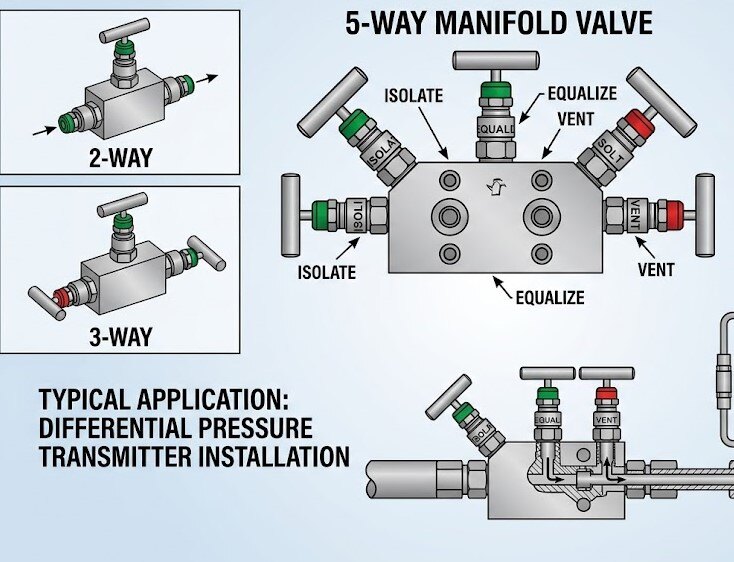
Structurally, manifold valves incorporate multiple internal valves, such as ball valves, needle valves, vent valves, or drain valves, arranged in standardized configurations. Based on the number and combination of valves, manifold valves are commonly classified into 2-valve, 3-valve, and 5-valve manifolds, each suited for different measurement scenarios.
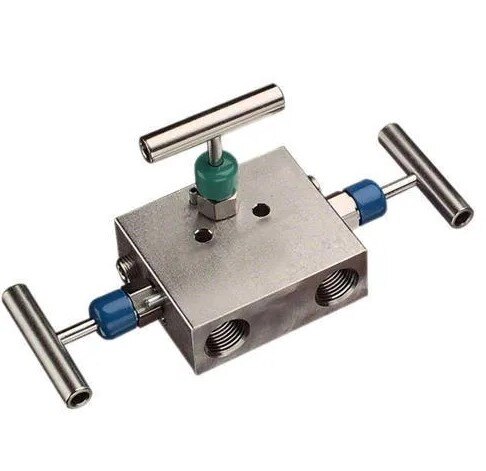
Based on the number of integrated valves and their functional configurations, manifold valves are mainly classified into the following three types:
A two-valve manifold consists of two valves, typically one isolation valve and one drain (or vent) valve. It is mainly used in static pressure transmitter systems and is suitable for gauge pressure measurements.
Gauge pressure refers to pressure measured relative to atmospheric pressure and is widely used in industrial applications.
Two-valve manifolds are available in straight, Y-type, or L-type configurations, allowing flexible installation based on space constraints. They are usually made of 316 stainless steel and feature connection types such as NPT threads or IEC standard interfaces.
In practice, when maintenance or replacement of a pressure instrument is required, the operator first closes the isolation valve to cut off the process medium, then opens the drain valve to release residual pressure, ensuring safe operation.
The three-valve manifold is the most common configuration used in differential pressure measurement systems. It consists of two isolation valves and one equalizing valve.
Differential pressure refers to the pressure difference between two points and is commonly used in flow measurement and level monitoring applications.
In standard configurations, the two isolation valves (often marked in blue) connect to the high-pressure and low-pressure sides of the process, respectively. The equalizing valve (typically green) is positioned between them.
During operation, the isolation valves control the connection between the instrument and the process. The equalizing valve is used to balance the pressure between the high- and low-pressure sides during startup or shutdown. This prevents excessive pressure from damaging sensitive differential pressure transmitters.
This protective function is essential for extending the service life of precision instruments.
A five-valve manifold expands on the three-valve design by adding more functionality, making it suitable for applications requiring higher safety and operational flexibility.
A typical five-valve manifold includes:
- Two isolation valves (blue)
- One equalizing valve (green)
- Two drain or vent valves (often red)
In liquid systems, the drain valves are used to discharge process fluids, while in gas systems, configurations may include additional equalizing valves or vent options.
The key advantage of a five-valve manifold is operational flexibility. It allows technicians to perform calibration, purging, or instrument replacement without shutting down the entire process system.
Manifold valves are designed to achieve a balance between sealing performance, ease of operation, and maintenance efficiency.
The valve body is typically made from high-strength metal, with precisely machined internal passages to ensure smooth fluid flow. The valve stem features an anti-blowout design, preventing it from being ejected under abnormal pressure conditions, thereby enhancing operational safety.
The stem surface is finely polished and combined with high-performance packing materials to achieve bubble-tight sealing with minimal operating torque, ensuring zero leakage performance.
For operation, manifold valves are usually equipped with T-handles designed for ergonomic use, allowing easy operation even when wearing gloves. Handle color coding follows industry standards:
- Blue for isolation
- Green for equalization
- Red for venting or draining
This system helps prevent operational errors.
The sealing system is a critical feature. The bonnet-to-body connection uses replaceable gaskets, allowing maintenance without removing the entire valve. The packing gland includes an adjustment mechanism and locknut to compensate for wear and prevent loosening due to vibration. Anti-rotation thrust washers ensure even packing distribution, minimizing cold flow and maintaining long-term sealing performance.
The choice of material directly affects the valve’s performance, cost, and application suitability.
Aluminum alloy manifold valves are lightweight and offer good corrosion resistance. The natural oxide layer provides protection against rust, and their high thermal conductivity aids heat dissipation. These valves are ideal for weight-sensitive applications such as aerospace, mobile equipment, or installations with limited support capacity. However, aluminum has lower mechanical strength and may require thicker walls for high-pressure applications.
Carbon steel and stainless steel manifold valves provide higher strength and pressure resistance. 316 stainless steel is widely used in chemical and oil industries due to its excellent corrosion resistance. Galvanized steel offers a good balance between cost and strength, making it suitable for general industrial applications.
For high-pressure or high-stress environments, steel is generally the preferred choice.
Manifold valves are widely used across various industries, from laboratory systems to large-scale industrial plants.
In the oil and gas industry, they are used for wellhead pressure monitoring, pipeline systems, and tank level measurement. These applications often involve remote locations, where reliability and low maintenance are critical.
In chemical processing plants, manifold valves are used in reactor pressure monitoring, distillation column differential pressure measurement, and process line isolation. Corrosive media require stainless steel construction, while frequent operation tests sealing durability.
In the power industry, they are used in boiler feedwater systems, steam pipelines, and cooling circuits to monitor critical parameters. In high-temperature and high-pressure environments, material selection and sealing performance are crucial for safe operation.
In hydraulic systems, manifold blocks act as centralized control hubs, integrating pumps, actuators, and control valves. Internal channels distribute flow, control direction, and regulate pressure, significantly simplifying external piping.
Compared with traditional multi-valve installations, manifold valves offer several significant benefits:
- Reduced leakage risk: Fewer connections mean fewer potential leak points, which is especially important when handling hazardous, flammable, or expensive media.
- Space saving: Compact, modular design allows complex functionality within limited space, ideal for dense industrial installations.
- Simplified maintenance: Instruments can be isolated without shutting down the entire process, enabling online maintenance and minimizing downtime.
- Lower total cost: Although the initial cost may be higher than individual valves, overall system costs are reduced due to fewer fittings, lower installation labor, and reduced maintenance.
- Improved system reliability: Factory-tested designs and standardized structures offer greater reliability than field-assembled valve systems, ensuring consistent monitoring of critical parameters.
When selecting a manifold valve, the first step is determining whether the application involves static pressure or differential pressure measurement. This determines whether a 2-valve, 3-valve, or 5-valve configuration is required.
Process conditions such as temperature, pressure, and media corrosiveness must be evaluated to select appropriate materials and sealing components.
Connection types should match existing systems, with options including NPT threads, metric threads, or flanged connections. Installation space may also dictate the choice of valve configuration (straight, L-type, etc.).
During operation, packing should be inspected periodically. If leakage occurs, it can be adjusted via the packing gland. Operators should apply steady force when turning handles and avoid using extension tools that may cause excessive torque.
Valves that remain idle for long periods should be operated periodically to prevent sticking.
As a fundamental component in modern industrial fluid control systems, manifold valves effectively address the limitations of traditional multi-valve configurations through integrated design.
From simple two-valve manifolds to fully functional five-valve systems, and from lightweight aluminum alloys to high-strength stainless steel, manifold valves provide reliable solutions for a wide range of industrial applications.
Understanding their working principles, configurations, and selection criteria enables engineers and technicians to design safer and more efficient fluid control systems. As industrial automation continues to advance, manifold valves will play an increasingly important role in ensuring measurement accuracy, simplifying maintenance, and enhancing system reliability.
For professionals involved in instrumentation, maintenance, or process design, mastering manifold valve knowledge is an essential skill for maintaining stable and efficient industrial operations.