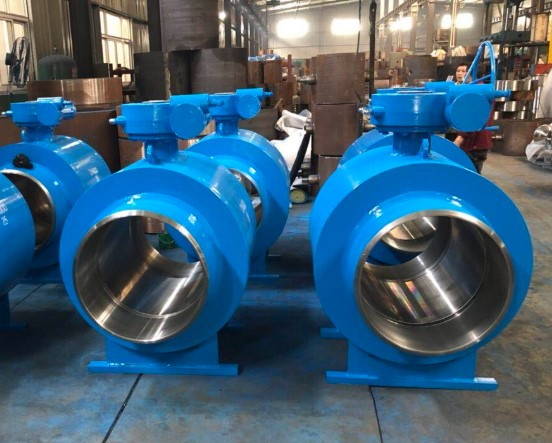
As a critical control device in long-distance pipelines, the structural design of a fully welded ball valve directly determines its sealing performance, service life, and operational safety. Compared with split-body ball valves, fully welded ball valves adopt an entirely welded body structure that eliminates the risk of external leakage, making them particularly suitable for the long-term, maintenance-free operation of high-pressure pipelines such as natural gas and petroleum systems. This article systematically outlines the core structural design principles of fully welded ball valves from multiple perspectives, including body configuration, seat sealing, stem design, and ball support.
The body design of fully welded ball valves is primarily divided into two forms: cylindrical and spherical. Each has distinct advantages and is suited to different application scenarios.
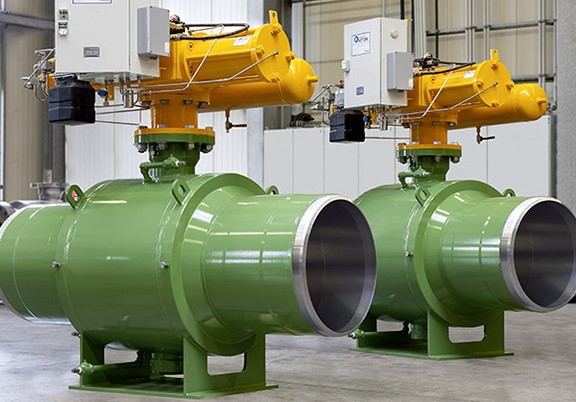
The cylindrical structure is currently one of the most widely used body designs. Its manufacturing process is relatively simple, requiring uncomplicated molds with lower tooling costs, making it suitable for small- to medium-batch production. Assembly is straightforward, positioning is convenient, and post-production repairs are easier to implement. More importantly, this structure allows for the installation of internal support plates to secure the ball, which is a significant structural advantage.
From a load-bearing perspective, cylindrical bodies typically feature a double-weld seam design. The high heat input during welding generates complex residual stresses that can lead to axial and radial deformation. However, the thicker cylindrical wall provides reliable resistance to pipeline loads and is less prone to distortion. Once installed, the valve body must withstand substantial pipeline stress and external forces caused by installation deviations, ground movement, and thermal stress. In this regard, the robust cylindrical body demonstrates strong reliability.
The primary drawback of this structure is its heavier weight due to thicker walls, resulting in higher material costs. This factor must be carefully considered in projects where pipeline weight is a critical concern.
Spherical valve bodies offer clear advantages in mechanical performance. Their stress distribution is superior to that of cylindrical structures, providing stronger resistance to bending and compression. With thinner walls and reduced weight, the overall structural performance is excellent.
Although spherical bodies involve higher initial tooling costs and more complex manufacturing processes, and internal ball support is more challenging, the total cost becomes lower than that of cylindrical valves in large-scale production.
When selecting a valve body structure, factors such as pipeline pressure rating, diameter, production volume, and transportation and installation conditions must be evaluated comprehensively. For large-diameter, high-pressure pipeline projects, the lightweight advantage of spherical structures becomes particularly evident.
Traditional ball valves widely used split-body designs, including side-entry and top-entry types. These structures generally consist of a valve body and left and right connectors joined by bolts. The connection flange thickness and bolt strength must be designed to match the internal diameter of the valve body, ensuring sufficient connection strength to prevent loosening caused by pipeline stress and avoid sealing failure. Face-to-face contact between the body and connectors leaves no gap, and the sealing system must meet fire-safe requirements, typically using a combination of rubber O-rings and spiral-wound metal gaskets.
However, split-body structures present a risk of external leakage, as bolted joints are potential leak points. With the rapid advancement of fully welded body technology in recent years, welded structures have gradually replaced split designs. Fully welded ball valves eliminate external leakage risks through complete welding, meeting modern pipeline requirements for zero leakage.
Seat sealing is the most critical technology in fully welded ball valves, directly affecting sealing performance and service life. To ensure reliability and achieve a design life exceeding 30 years, modern fully welded valves incorporate multiple structural measures.
The double-piston effect is a highly efficient sealing structure. In this design, the sealing center between the seat and the ball lies on the same cylindrical surface as the seat sealing ring. Both the seat support ring and sealing ring are movable, functioning like two pistons, hence the name.
A double-sealed seat can achieve sealing in both directions. When upstream pressure exceeds the cavity pressure, the medium pushes the seat sealing ring toward the ball, increasing the contact pressure and ensuring a tight seal. Conversely, when cavity pressure exceeds upstream pressure, it pushes the sealing ring toward the upstream side, altering the force distribution so that the seat still presses tightly against the ball.
Regardless of whether upstream or downstream pressure is higher, the seat maintains firm contact with the ball, fulfilling bidirectional sealing requirements.
Unlike the double-piston design, the sealing ring in a single-piston seat is fixed, and only the seat support ring is movable. The distance from the sealing ring to the valve center (A) is greater than the distance from the seat-ball contact point to the center (B).
When upstream pressure exceeds cavity pressure, the support ring is pushed toward the ball to achieve sealing. When cavity pressure becomes higher than upstream or downstream pressure, it forces the support ring away from the ball, allowing the cavity pressure to automatically relieve toward the lower-pressure side.
The double-piston double-sealed structure is highly effective and essential for valves requiring a service life of over 30 years. If one seat is damaged, the other can still function independently, and this redundancy significantly enhances reliability.
In contrast, the self-relieving single-seat structure has notable limitations. If one seat fails, the medium can enter the cavity and increase internal pressure, weakening the sealing capability of the opposite seat and potentially causing leakage once the pressure exceeds the design threshold. From a reliability standpoint, double sealing is superior.
However, the double-piston design does not automatically relieve cavity pressure, which introduces safety risks. When the valve remains fully open or closed, trapped media may cause abnormal pressure increases due to rapid temperature changes. Calculations show that gas trapped in the cavity can see its pressure rise to 1.41 times the original value when the temperature increases from –30°C to 70°C, a condition common in northwestern regions with extreme seasonal variations.
Liquids pose an even greater hazard because of their incompressibility. Therefore, fully welded ball valves with double-piston seats must be equipped with a pressure relief valve, typically set to open at 1.1 to 1.33 times the nominal pressure, with a diameter not less than 1/2 inch.
Pipeline ball valves typically employ combined sealing approaches, often integrated with a sealant injection system.
Metal seals reduce erosion and scratching of soft seats caused by pipeline impurities, extending service life. They also absorb most of the thrust from the medium, preventing overload damage to the soft seat. The metal seat material is usually at least equal in grade to that of the ball.
Soft seats are mainly available in triangular and O-ring shapes. Both offer similar sealing principles and performance, commonly using VITON AED (anti-explosive fluoroelastomer). Triangular seals are more difficult to manufacture but easier to assemble, and their grooves are simpler to machine than O-ring grooves. Most international manufacturers favor triangular seals, which are also predominant in domestic production.
A small number of manufacturers adopt a triple-sealing design by adding a nylon seal in addition to the ball and seat. This helps prevent impurities from damaging sealing surfaces, while also scraping debris from the ball during operation to protect the rubber soft seal and extend valve life.
However, nylon seats are difficult to assemble and may detach from the groove if not properly secured. Limited installation space prevents them from being made wider, increasing the risk of overload damage. Materials such as nylon, reinforced PTFE, and PEEK are more commonly used in split high-pressure ball valves rather than fully welded designs because they are harder, less resilient, and more susceptible to abrasion from welding slag, rust, and sand.
These sealing methods are often paired with a sealant injection system consisting of injection and check valves installed near the seat area and stem packing. This serves as an emergency measure to reduce leakage and defer comprehensive maintenance until the next scheduled pipeline shutdown.
Before injection, the seat area should be flushed by opening the valve approximately 15 degrees three to four times to clean the contact surfaces. Sealing performance must be tested afterward.
The stem seal is another critical technology in fully welded ball valves. Failure here can lead to media leakage, environmental pollution, or even fire hazards.
A widely used design employs two O-rings forming dual sealing barriers, supplemented by flexible graphite for enhanced reliability. Flexible graphite performs particularly well in fire conditions by minimizing leakage.
More advanced designs separate the two O-rings, allowing the outer seal to be serviced or replaced under pressure if leakage occurs.
Some international designs combine an O-ring, flexible graphite, and a spring-energized sealing ring. Each material contributes distinct advantages: O-rings provide elasticity but have limited temperature resistance; graphite withstands high temperatures but has lower resilience; and the spring-energized PTFE seal offers excellent long-term sealing by compensating for wear and microscopic surface irregularities. This configuration is especially suitable for sour natural gas applications.
The ball requires extremely high machining precision, with roundness controlled within 0.005 mm. Surfaces are typically treated with electroless nickel plating, with a coating thickness greater than that of the seat. For large-diameter, high-pressure valves, ball deformation must be calculated, as excessive deformation can lead to sealing failure.
Two main support structures are used:
Support Plate Design: The ball is supported by a plate, and the stem is independent of the ball. Medium thrust is transmitted to the body through the support plate, reducing operating torque and protecting the stem seal. This configuration is commonly used in cylindrical bodies.
Upper and Lower Stem Support: Typically applied in spherical bodies, the ball is supported by both stems, which transmit medium thrust to the body. Because the stem bears this load, operating torque is higher, and seal wear may accelerate.
Pipeline valves must incorporate fire-safe structures. Key considerations include fire protection for the seat, stem, and body joints, with seat fire resistance being the most critical.
Graphite seals are commonly installed around the stem and seat support rings due to their excellent high-temperature resistance and ability to reduce leakage during fires.
Since friction between the ball, stem, and non-metallic materials can generate static electricity, anti-static springs are installed to conduct the charge to the valve body. Standards typically require the resistance between the ball and body, and between the stem and ball, to remain below 10 ohms under 12 V DC.
The Double Block and Bleed (DBB) function ensures that both upstream and downstream seats provide simultaneous isolation when the cavity is depressurized, regardless of whether the valve is open or closed. It also allows online seat sealing tests through the bleed valve without interrupting pipeline operation.
Other auxiliary features, such as venting, drainage, sealant injection, and lifting lugs, generally follow established standards and engineering practices, with no fundamental differences between domestic and international design philosophies.
The structural design of fully welded ball valves is a comprehensive engineering discipline. From body selection to sealing configuration, from ball machining to safety functions, every element influences the valve’s ultimate performance and longevity. As pipeline operators demand higher reliability, technologies such as double-piston double-sealed seats, fully welded bodies, and multi-layer sealing protection have become industry-standard configurations. Designers must carefully match structural forms to specific operating conditions to ensure safe and reliable valve performance throughout a design life of 30 years or more.