Swing Check Valves vs. Tilting Disc Check Valves
In industrial piping systems, preventing backflow is essential for ensuring equipment safety, maintaining stable system operation, and protecting downstream processes. Check valves serve as the primary devices to achieve this function. They operate automatically, opening and closing in response to fluid pressure and flow, without the need for manual intervention or external actuators. This self-acting characteristic makes them indispensable at critical points such as pump discharge lines, pipeline branches, and boiler feedwater systems.
Among the various types of check valves, swing check valves and tilting disc check valves are the most commonly used designs for large-diameter pipelines and heavy-duty applications. Although both types share the fundamental function of opening under forward flow and closing under reverse flow, they differ significantly in structural principles, response speed, pressure loss, and resistance to water hammer. A thorough understanding of these differences is vital for engineers to make informed selections, optimize system safety, and reduce operational risks.
Swing check valves are one of the most traditional and widely deployed designs in industrial applications, valued for their simplicity, reliability, and proven engineering track record. These valves operate using a classic swinging mechanism and are highly suitable for general industrial conditions. The following sections provide a detailed overview of their working principle, advantages, and limitations.
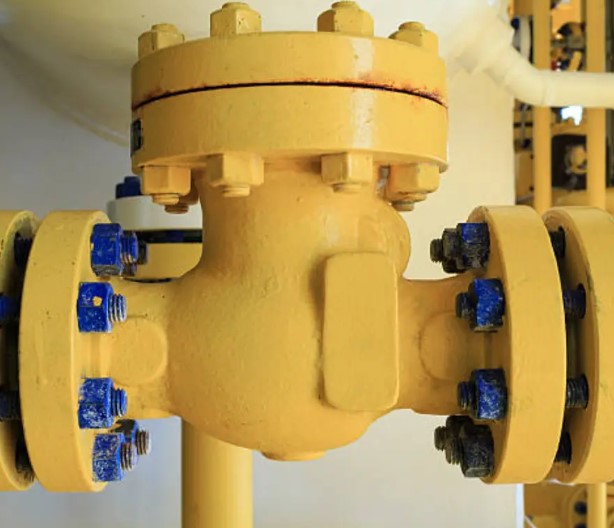
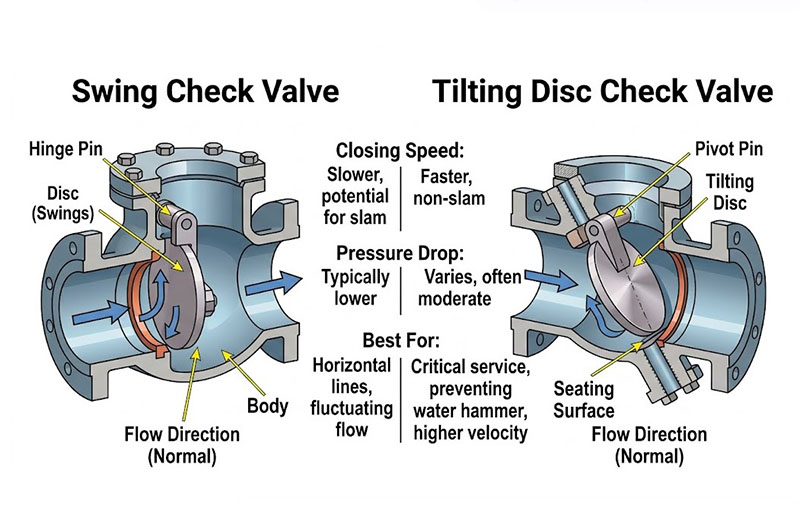
The swing check valve consists of a valve body, a disc, and a hinge mechanism. The disc is connected to the valve body at the top via a hinge pin, allowing it to swing freely within the flow path.
During forward flow, fluid pressure pushes the disc upward, causing it to rotate around the hinge to a nearly horizontal position. This creates an almost full-bore flow passage, minimizing flow resistance and allowing the medium to pass smoothly. When the flow stops or reverse pressure occurs, the disc returns to its closed position under the combined influence of gravity and the reverse fluid pressure, sealing against the valve seat to prevent backflow.
This simple yet effective mechanism ensures that the valve functions automatically without external control, making it a reliable component for protecting pumps, compressors, and other downstream equipment.
- Low Pressure Drop: In the fully open position, the disc is largely out of the flow path, forming an almost unrestricted passage. This design minimizes resistance and reduces pressure loss, which is especially beneficial for long-distance pipelines or energy-sensitive systems. Reduced pressure loss translates directly into lower operational costs by decreasing pumping energy requirements.
- Excellent Passage Capability: With the disc fully lifted, the flow path is unobstructed, allowing smooth transport of solids, fibrous materials, or viscous fluids. This feature makes swing check valves particularly suitable for challenging media such as wastewater, slurry, or mineral-laden fluids. Solid particles can pass through without obstruction, reducing the risk of clogging and maintaining system efficiency.
- Simple Structure and Easy Maintenance: Swing check valves are composed of relatively few components. The disc and hinge are the primary moving parts, which can be removed and replaced easily. Routine maintenance typically involves checking hinge wear and inspecting the sealing surface. The technical threshold is low, so on-site personnel can handle most maintenance tasks without specialized tools.
- Cost-Effectiveness: Due to their simple construction and mature manufacturing process, swing check valves are relatively inexpensive to produce. This cost advantage becomes especially significant for large-diameter pipelines. For projects with budget constraints or for bulk procurement scenarios, the lower initial investment makes swing check valves an attractive option.
Slow Closure Speed: The disc requires a large swinging motion to move from the fully open to the fully closed position, which can delay closure. In cases of rapid flow reversal, the disc may not close in time, allowing backflow and generating pressure surges known as water hammer.
- Water Hammer Risk: Water hammer is a pressure surge caused by the sudden closure of a valve or abrupt pump stoppage. Swing check valves, due to their slow response, often fail to prevent such surges, which can damage pipelines, valves, and connected equipment. The problem is particularly acute in high-lift pumping systems or long-distance pipelines.
- Disc Flutter: Under low flow rates or turbulent conditions, the disc may oscillate near a partially open position. This fluttering can accelerate hinge wear, generate noise and vibration, and over time may damage the sealing surface, reducing the valve’s ability to prevent backflow.
- Installation Limitations: Swing check valves are generally designed for horizontal installation, with the hinge at the top. In vertical installations, the flow direction must be upward to lift the disc. Downward flow may keep the disc pressed against the seat, preventing proper operation. This restricts installation flexibility in some confined spaces.
To address the shortcomings of swing check valves, primarily slow closure and susceptibility to water hammer, the tilting disc check valve was developed. By redesigning the disc support and motion trajectory, this valve achieves faster response and smoother closure, mitigating backflow risks and providing enhanced safety in sensitive applications.
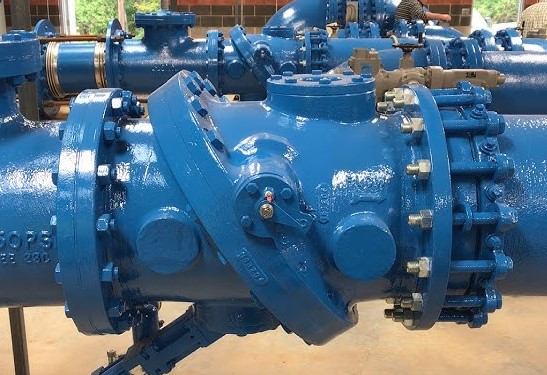
The tilting disc check valve modifies the disc pivot location to create an eccentric support structure, unlike the top-mounted hinge in swing check valves. The pivot is positioned closer to the disc center.
This eccentric pivot allows the disc to tilt rather than swing. During forward flow, fluid pressure tilts the disc open, separating it from the seat and forming a flow channel. The short opening stroke and the disc’s center-of-gravity design near the closed position allow rapid return to seal against reverse flow, effectively preventing backflow before significant pressure buildup occurs.
- Rapid Closure to Prevent Backflow: The short stroke and optimized center of gravity enable the disc to close quickly, minimizing backflow volume and reducing water hammer risk. This feature is crucial for high-lift pumps and sensitive piping systems.
- Smooth, Impact-Free Closure: Unlike swing check valves, where the disc may slam into the seat, the tilting disc valve closes with sliding contact. This reduces impact forces, protects the sealing surfaces, and extends the valve’s service life.
- Stable Operation: The disc remains stable even under turbulent or pulsating flows. The design ensures minimal sensitivity to flow fluctuations, reducing mechanical wear and operational noise.
- Reliable Sealing: The fast and smooth closure ensures consistent contact between the disc and the seat, providing high sealing reliability. This is particularly important in high-purity pipelines or chemical processing where backflow could cause contamination or process disruption.
- Higher Pressure Drop: The disc remains partially in the flow path, even when fully open, resulting in greater flow resistance and pressure loss compared to full-bore swing check valves. This factor must be considered in energy-sensitive or high-flow systems.
- Unsuitable for Solid-Laden Media: Particles or fibrous material can catch on the disc or its support structure, potentially causing jamming or incomplete closure. Tilting disc valves are best suited for clean media such as water, refined oil, or chemical solutions.
- High Manufacturing Precision Required: The eccentric pivot, disc center-of-gravity, and seat fit require tight machining tolerances and precise assembly. This increases production costs and makes the valve more expensive than swing check valves.
- Maintenance Requires Technical Skill: While routine maintenance is limited, repairing or adjusting the disc’s eccentric pivot and center of gravity requires specialized tools and skilled personnel. On-site maintenance is more challenging compared to swing check valves.
Feature | Swing Check Valve | Tilting Disc Check Valve |
Closure Speed | Slow, large swing stroke | Fast, short tilting motion |
Water Hammer Risk | High, larger backflow volume | Low, rapid cut-off of backflow |
Pressure Loss | Very low, near full-bore | Moderate, disc partially in flow |
Passage Performance | Excellent, handles solids | Poor, clean media only |
Operational Stability | Disc may flutter at low flow | Stable under turbulence |
Sealing Reliability | May decrease over time | High, smooth closure |
Installation Flexibility | Usually horizontal only | Some designs allow multiple orientations |
Manufacturing Cost | Low | High |
Maintenance Difficulty | Simple, low skill required | Complex, requires expertise |
Proper valve selection involves translating technical characteristics into practical decisions based on media properties, system dynamics, safety requirements, and cost considerations.
- Media with solids: Mud, sand, ore, or fibrous debris; full-bore design prevents clogging.
- Pigging operations: Pipelines requiring cleaning pigs; unobstructed passage ensures smooth operation.
- Energy-sensitive systems: Low pressure loss reduces pumping energy and operational cost.
- Budget constraints: Lower initial cost is advantageous for large-diameter pipelines.
- Stable flow systems: Minimal flow fluctuation reduces disc flutter, allowing simple maintenance.
- High-lift pump outlets: Rapid closure protects pumps and pipelines from backflow.
- Water hammer-sensitive systems: Protects fragile pipelines and precision equipment.
- Frequent pump start-stop cycles: High reliability and long service life.
- Clean media transport: Ideal for water, refined oil, or chemical solutions, avoiding clogging.
- Critical safety locations: Quick response and reliable sealing enhance safety in key positions.
- Assess media properties: Determine cleanliness, solid content, viscosity, and corrosivity.
- Evaluate system dynamics: Review pump operation, shutdown frequency, system pressure, and water hammer risk.
- Analyze economic factors: Compare initial costs, energy consumption, maintenance, and lifecycle cost.
- Consider installation and maintenance conditions: Account for space, personnel skill, and spare part availability.
- Determine technical specifications: Select valve size, pressure rating, and material. Consult the manufacturer if necessary.
Swing check valves and tilting disc check valves each have distinct advantages and applications. Swing valves excel in low-pressure-drop, high-throughput systems handling solids, while tilting disc valves provide rapid closure, water hammer protection, and reliable performance in clean media and critical safety locations.
Engineers should not base valve selection solely on cost or habit. Instead, they must consider media properties, system dynamics, safety requirements, and lifecycle costs. Properly matching valve characteristics to specific operational conditions ensures safe, efficient, and economical pipeline operation. For complex or critical systems, consulting the manufacturer and performing computational fluid dynamics (CFD) simulations or flow analysis can further validate the selection, ensuring scientific and reliable decision-making.