Ceramic Butterfly Valves for Severe Service
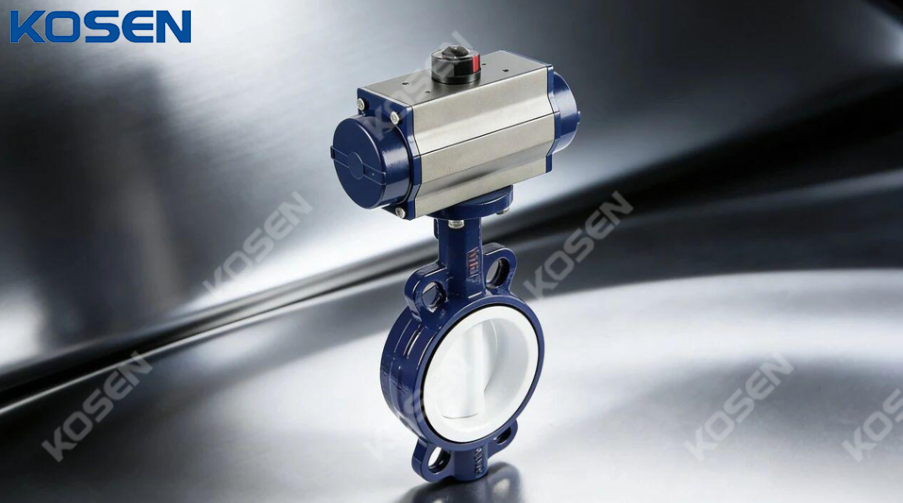
Ceramic butterfly valves have emerged as a specialized solution for these challenging conditions. By incorporating engineered ceramic materials into critical wetted and sealing components, these valves can provide excellent resistance to abrasive wear, erosion, and many corrosive media. Their value is particularly evident in applications where conventional metal valves experience rapid seat deterioration, disc damage, or corrosion.
However, ceramic butterfly valves are not a universal replacement for metal valves. Their advantages depend strongly on the operating conditions and valve design. Ceramic materials offer exceptional hardness and chemical stability, but they can also be more sensitive to impact and thermal shock than ductile or alloy metals. Therefore, successful application requires a balanced assessment of wear, corrosion, pressure, temperature, particle size, flow velocity, operating mode, and valve geometry.
Conventional valve selection often starts with pressure, temperature, and fluid compatibility. These remain essential, but they may not fully describe a severe-service application. A valve handling clean water at moderate pressure may operate for many years with limited maintenance, while the same valve geometry exposed to a high-solids slurry can experience rapid deterioration within a much shorter period.
The difference is caused by the interaction between the fluid and the valve's internal surfaces. Solid particles can strike, slide across, or become trapped against sealing surfaces. Corrosive chemicals can attack exposed metal. High flow velocities can accelerate erosion, while repeated opening and closing can introduce additional mechanical wear.
A severe-service valve therefore needs materials and geometry that address the actual degradation mechanisms rather than simply satisfying the nominal pressure rating.
Common degradation mechanisms include:
- Abrasive wear caused by solid particles sliding against surfaces
- Erosion caused by high-velocity particle impact
- Corrosion caused by chemically aggressive fluids
- Corrosion-assisted wear caused by simultaneous chemical and mechanical attack
- Cavitation-related damage in certain pressure-drop conditions
- Particle accumulation and valve-seat obstruction
- Mechanical impact caused by large particles
- Thermal shock caused by rapid temperature changes
Ceramic butterfly valves are particularly attractive when abrasion and corrosion occur simultaneously because engineered ceramics can offer a combination of high hardness and strong chemical resistance.
The most important characteristic of many engineering ceramics is their very high hardness. Materials such as alumina, zirconia, silicon carbide, and other advanced ceramic compositions can offer wear resistance significantly different from that of conventional valve metals.
In abrasive service, hardness is important because it helps resist material removal when particles pass through the valve. When a slurry contains hard mineral particles, the particles can gradually cut, scratch, or deform softer surfaces. A harder ceramic surface can substantially reduce this type of damage when the ceramic grade and design are appropriate for the application.
However, hardness alone does not determine valve life. Particle shape, concentration, velocity, size distribution, impact angle, fluid viscosity, and surface geometry also influence wear. A highly abrasive slurry moving at high velocity can still damage ceramic components if the valve is improperly selected or operated.
Ceramics are also attractive because many engineering ceramic compositions exhibit strong resistance to a broad range of chemicals. This can be particularly useful in applications involving acidic or alkaline slurries.
Conventional carbon steel may require extensive protective coatings or linings when exposed to aggressive chemicals. If the coating is damaged, the underlying metal can rapidly corrode. A suitable ceramic wetted surface can reduce dependence on such protective barriers.
Nevertheless, “ceramic” should not be treated as a single material category. Different ceramic compositions have different chemical resistance characteristics. The specific ceramic grade must therefore be evaluated against the actual process fluid, concentration, temperature, and exposure time.
Abrasive wear occurs when solid particles move relative to a valve surface and remove material through cutting, plowing, scratching, or repeated deformation.
Slurries containing quartz, silica, metal oxides, coal particles, mineral concentrates, or other hard solids can be particularly aggressive. The risk becomes greater when particle concentration and velocity increase.
Valve seats are often especially vulnerable because they must maintain a tight sealing interface while being exposed to the process medium. Once the sealing surface becomes damaged, internal leakage may increase rapidly.
Ceramic sealing components can reduce wear in such environments, helping maintain sealing performance for longer periods.
Erosion is closely related to fluid velocity and particle impact. Unlike simple sliding abrasion, erosive wear can occur when particles repeatedly strike a surface at significant velocity.
Valve geometry has a major influence on erosion. Sharp changes in flow direction, restricted passages, and partially opened valves can create localized regions of high velocity and turbulence.
This is one reason why severe-service ceramic butterfly valves are generally more suitable for isolation applications than for continuous throttling. Keeping the valve fully open or fully closed can minimize the time that the disc and sealing surfaces remain exposed to unfavorable high-velocity flow patterns.
Butterfly valves have a relatively simple construction consisting primarily of a body, disc, shaft, seat or sealing system, and actuator or manual operating mechanism. Their quarter-turn operation allows rapid opening and closing, while their compact dimensions make them attractive for large pipeline diameters.
When critical internal surfaces are manufactured from or protected by suitable ceramic materials, this basic butterfly-valve architecture can be adapted for abrasive and corrosive service.
Several characteristics make the design attractive:
| Characteristic | Practical Benefit |
|---|---|
| Compact structure | Reduced installation space |
| Quarter-turn operation | Fast isolation |
| Large-diameter suitability | Useful for high-flow pipelines |
| Ceramic wetted surfaces | Improved wear resistance |
| Ceramic sealing components | Better resistance to abrasive leakage |
| Low material reactivity | Useful for selected corrosive fluids |
| Relatively simple construction | Potentially easier maintenance |
| Reduced replacement frequency | Lower lifecycle maintenance cost |
The actual benefits depend on the specific design. A butterfly valve with ceramic components is not automatically suitable for severe service unless the body, disc, shaft, seat, bearings, coating, and actuator are all engineered for the intended conditions.
Mining operations are among the most demanding environments for fluid-control equipment. Ore slurries can contain high concentrations of hard mineral particles, creating severe abrasion and erosion.
Slurry pipelines may transport crushed ore, concentrates, tailings, or process residues over considerable distances. Conventional valve seats and internal surfaces can suffer rapid wear when exposed to these fluids.
Ceramic butterfly valves can provide an alternative where their pressure, temperature, and mechanical limitations are compatible with the process. Their wear-resistant internal components can help reduce seat deterioration and extend maintenance intervals.
Tailings often contain fine mineral particles that remain suspended in water. Although particle size may be relatively small, high solids concentration can produce significant abrasive effects over time.
Valve selection should consider solids concentration, particle hardness, slurry density, velocity, and operating frequency. A valve that performs well with diluted slurry may not perform equally well with a high-density mixture.
For this reason, ceramic valve selection should be based on actual process data rather than simply specifying “slurry service.”
Coal preparation plants and aggregate-processing facilities use extensive water and slurry systems. Dense media, coal slurry, wash water, and mineral-laden wastewater can expose valves to abrasive particles.
Sand and aggregate processing can be especially challenging because silica-rich particles are highly abrasive. Valves installed in these systems must withstand repeated exposure to suspended solids while maintaining acceptable sealing performance.
Ceramic components can be advantageous because of their high hardness. However, large particles or sudden impact events can create a different failure mechanism. This distinction is important because resistance to gradual abrasion does not necessarily mean resistance to severe mechanical impact.
Thermal power plants can contain highly corrosive and abrasive slurry systems. In wet flue gas desulfurization systems, limestone or lime-based slurries react with sulfur compounds to reduce sulfur dioxide emissions.
The resulting slurry can contain suspended solids and chemically aggressive components. Valve components may therefore experience both abrasive and corrosive attack.
This combination makes material selection particularly important. A metal component that has acceptable corrosion resistance may still experience accelerated wear from suspended particles, while a material with good wear resistance may not provide adequate chemical compatibility.
Ceramic valve components can address both challenges when the specific ceramic material is compatible with the slurry chemistry.
Fly ash, bottom ash, and slag transport systems can expose valves to high concentrations of fine abrasive particles. Dry ash systems and wet ash-handling systems have different requirements, so the valve configuration must be selected according to the actual process.
In dry pneumatic conveying systems, particle velocity can be high, making erosion a major consideration. In wet systems, the combination of water and solids can produce slurry-related abrasion.
Ceramic surfaces can reduce wear in suitable locations, but system velocity and valve position remain critical design factors.
Chemical processing facilities frequently handle acids, alkalis, corrosive slurries, and reactive process fluids. Material compatibility is therefore a major concern.
A valve body made from a conventional metal may require lining or coating to protect the substrate. If the lining becomes damaged, localized corrosion may develop beneath the protective layer.
Ceramic materials can provide a stable wetted surface in many chemical environments. Their resistance to chemical attack can help reduce material degradation and extend service intervals.
However, chemical compatibility must always be verified for the exact ceramic composition. Some chemicals can attack specific ceramic materials, while temperature can significantly influence chemical resistance.
One of the most challenging situations occurs when corrosion and abrasion happen simultaneously. A corrosive fluid can weaken or remove a protective surface, while abrasive particles continuously expose fresh material.
This combined mechanism is often referred to as erosion-corrosion or corrosion-assisted wear. It can be considerably more damaging than either mechanism acting independently.
Ceramic components can be valuable in these environments because their chemical stability and hardness can provide two layers of resistance.
Cement plants and building-material facilities often transport abrasive powders and particle-laden gases. Dust systems, ash systems, raw-material handling, and process-gas pipelines can create substantial wear on conventional metal components.
Ceramic-lined or ceramic-component butterfly valves can be considered where the process temperature and mechanical conditions are within the valve's design limits.
Temperature deserves particular attention in cement applications. Some process gases can reach temperatures far beyond the capabilities of ordinary elastomeric seats and standard butterfly-valve configurations.
A ceramic component may tolerate high temperatures better than an elastomer, but the complete valve still contains other components with their own limitations. The body, shaft, bearing, actuator, seals, and external materials must all be evaluated.
Municipal wastewater and environmental treatment systems can also involve difficult media. Sewage, sludge, sand-containing water, landfill leachate, and industrial wastewater can combine suspended solids with chemically aggressive substances.
In grit-removal and sludge-handling systems, abrasion can become a major maintenance issue. In landfill leachate applications, chemical compatibility can become equally important.
Ceramic butterfly valves may provide value where conventional valves experience frequent seat or internal-surface degradation.
Nevertheless, wastewater systems often contain debris and irregular solids. Large foreign objects can create impact loads that are fundamentally different from gradual abrasive wear. A complete process assessment should therefore include the possibility of unexpected solids entering the pipeline.
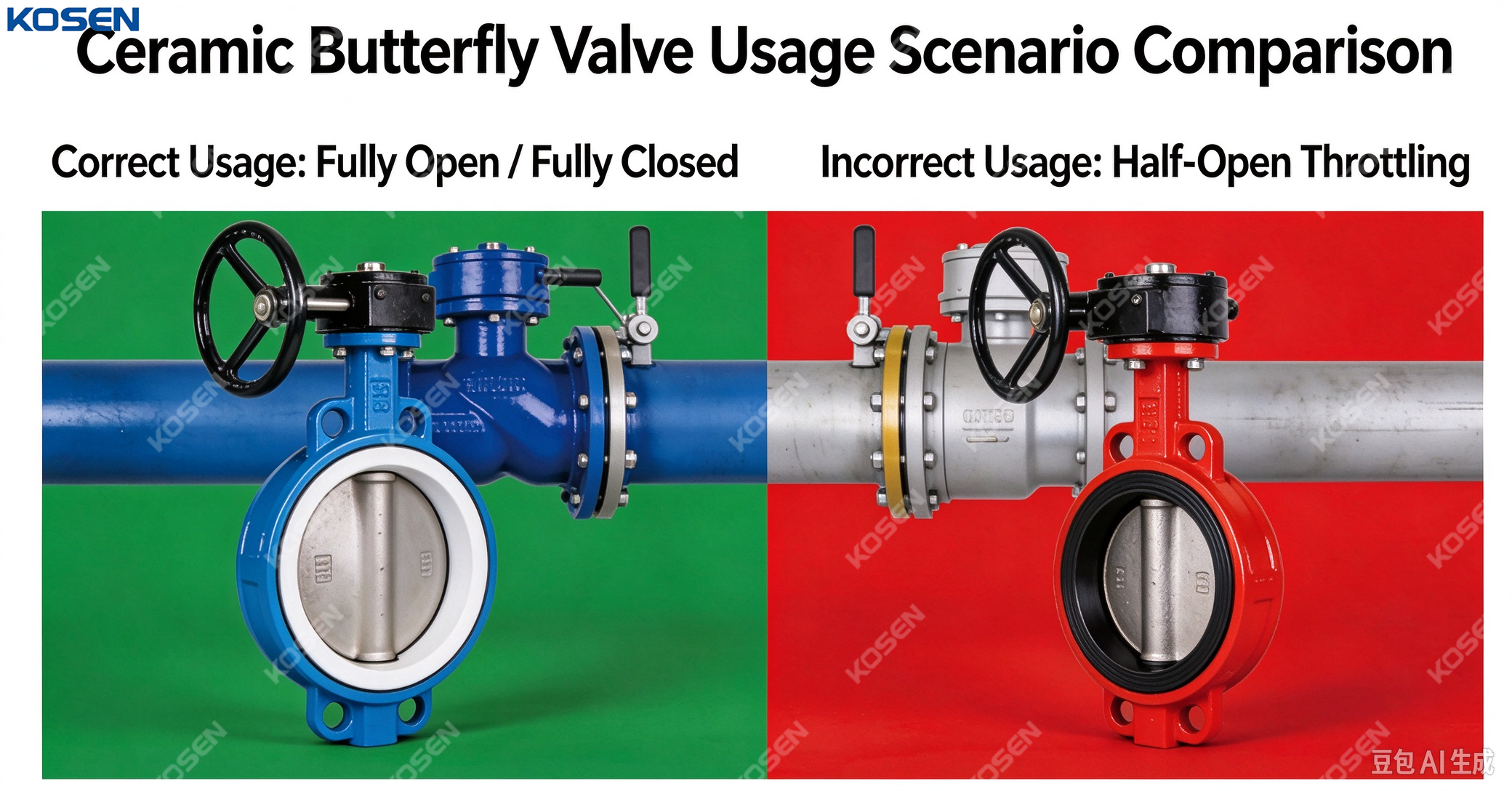
One of the most important considerations in ceramic butterfly valve selection is operating position. A butterfly valve is generally most favorable for severe abrasive service when it is used primarily for isolation.
When a butterfly valve is partially open, the disc remains in the flow path. This can produce localized high velocity and turbulence around the disc edges and sealing areas.
In abrasive service, the resulting particle impact can accelerate wear. If the process requires continuous flow regulation, a purpose-designed severe-service control valve may be more appropriate.
This does not mean every ceramic butterfly valve is incapable of throttling. Certain engineered designs can support limited regulating service. The key issue is whether the manufacturer has specifically rated the valve for the intended throttling conditions.
For severe-service applications, valve geometry can be just as important as material selection.
A conventional concentric butterfly valve keeps the shaft and disc geometry centered relative to the sealing surface. This can create continuous contact between the disc and seat during rotation.
Double-offset and triple-offset designs alter the relationship between the shaft, disc, and sealing surfaces. The resulting cam-like movement can reduce rubbing during opening and closing and help minimize mechanical wear.
This is particularly valuable when the sealing system needs to withstand abrasive media or when the valve is expected to operate frequently.
Offset butterfly valves can provide operational advantages, but they should not automatically be specified for every application. The appropriate design depends on pressure, temperature, shutoff requirements, cycling frequency, medium characteristics, and available sealing materials.
In high-cycle applications, reducing unnecessary rubbing between sealing surfaces can improve service life. In abrasive slurry applications, minimizing contact and particle entrapment can also reduce the risk of seat damage.
Ceramic butterfly valves are often associated with medium- and low-pressure applications, and many available designs are intended for pressure ratings such as PN10, PN16, PN25, or selected applications up to PN40.
However, PN40 should not be interpreted as a universal upper limit for all ceramic butterfly valves. Pressure capability depends on the complete valve construction, body material, ceramic components, sealing system, diameter, design standard, temperature, and manufacturer qualification.
Engineers should always use the manufacturer's certified pressure-temperature rating for the selected model.
Temperature is equally important. Ceramic materials can maintain their mechanical and chemical properties at temperatures where many polymers and elastomers degrade.
However, the ceramic itself is only one component of the valve. Seat materials, gaskets, shaft seals, bearings, coatings, and actuator components may impose lower operating limits.
Thermal expansion differences between ceramics and metals must also be considered. Ceramics generally have different coefficients of thermal expansion from steel and other metals. Rapid temperature changes can therefore create internal stresses and potentially lead to cracking or loss of sealing integrity.
High hardness is one of the greatest advantages of engineering ceramics, but it is also important to understand their limitations.
Unlike ductile metals, many ceramics have limited ability to plastically deform before fracture. A metal component may absorb a sudden impact by deforming, while a ceramic component may crack if the impact exceeds its fracture resistance.
This means that ceramic valve designs should be protected against:
- Large foreign objects
- Severe mechanical impact
- Improper installation
- Excessive pipeline stress
- Sudden thermal shock
- Extreme water hammer
- Incorrect actuator torque
- Misalignment
The design should therefore balance hardness and wear resistance with fracture toughness and mechanical reliability.
Pressure transients are another important consideration. Rapid valve closure can generate water hammer in liquid-filled pipelines, especially when flow velocity is high and the pipeline is long.
The resulting pressure spike can significantly exceed the normal operating pressure. Even if the valve's nominal pressure rating appears adequate, repeated transient loading may create additional stress on the valve, pipeline, supports, and other equipment.
For ceramic valves, pressure-transient analysis is particularly important because brittle materials generally tolerate sudden mechanical shock less readily than ductile metals.
Where rapid closure is unavoidable, engineers should evaluate actuator speed, pipeline geometry, fluid velocity, surge-control equipment, and valve closure characteristics.
A ceramic butterfly valve must be paired with an actuator that provides the correct torque without excessive mechanical loading.
Potential actuator options include:
- Manual gear operators
- Electric actuators
- Pneumatic actuators
- Hydraulic actuators
For automated systems, torque requirements should account for breakaway torque, running torque, seating torque, differential pressure, packing friction, and safety factors.
An oversized actuator is not necessarily safer. Excessive torque can place unnecessary loads on the shaft, disc, ceramic components, and valve body. The actuator should therefore be selected based on verified valve torque data.
Ceramic valves are often selected because they can reduce maintenance frequency, but they still require appropriate inspection.
A preventive maintenance program should monitor:
Inspect the valve body, coating, flange connections, bolts, actuator, and mounting structure. External corrosion or mechanical damage should be addressed before it affects the valve's structural integrity.
Monitor for external and internal leakage. Changes in leakage rate may indicate seat deterioration, foreign material, misalignment, or other developing problems.
Increasing operating torque can be an early indication of particle accumulation, mechanical interference, bearing deterioration, or actuator problems.
For automated valves, confirm that actual valve position corresponds to the actuator feedback signal. Incorrect position feedback can lead to process-control problems even when the valve itself remains mechanically functional.
Before selecting a ceramic butterfly valve for severe service, engineers should establish the following parameters:
| Parameter | Key Question |
|---|---|
| Medium | What fluid or slurry is being transported? |
| Solids | What are particle size, hardness, and concentration? |
| Velocity | What is the normal and maximum flow velocity? |
| Pressure | What are operating, design, and transient pressures? |
| Temperature | What are normal and maximum temperatures? |
| Corrosion | Is the medium chemically aggressive? |
| Valve function | Isolation or continuous modulation? |
| Cycle frequency | How often will the valve operate? |
| Valve diameter | What is the required nominal size? |
| Connection | Flanged, wafer, lug, or another configuration? |
| Ceramic material | Which ceramic composition is specified? |
| Sealing | Which seat and gasket materials are compatible? |
| Actuation | Manual, electric, pneumatic, or hydraulic? |
| Certification | Are special industry approvals required? |
| Maintenance | How accessible is the valve for inspection? |
This information gives the valve manufacturer enough data to evaluate whether a ceramic butterfly valve is genuinely appropriate rather than simply selecting one based on nominal diameter and pressure.
| Feature | Ceramic Butterfly Valve | Conventional Metal Butterfly Valve |
|---|---|---|
| Abrasion resistance | Very high for suitable ceramic grades | Depends strongly on metal and coating |
| Corrosion resistance | High for compatible media | Material-dependent |
| Impact resistance | Design-dependent; ceramics can be brittle | Generally good for ductile metals |
| Particle service | Highly suitable in selected applications | Depends on seat and internal materials |
| Chemical slurry | Potentially excellent | Requires careful alloy or lining selection |
| Throttling service | Application-specific | More widely available |
| Thermal shock | Requires careful evaluation | Generally more forgiving |
| Large diameter | Suitable for many applications | Widely available |
| Maintenance | Potentially reduced | Depends on service severity |
| Initial cost | May be higher | Often lower |
| Lifecycle cost | Can be favorable in severe wear | Can rise with frequent replacement |
The comparison demonstrates why ceramic valves should be evaluated based on lifecycle cost rather than purchase price alone. A higher initial equipment cost may be justified if the valve significantly extends operating life and reduces shutdowns, replacement labor, and spare-parts consumption.
The financial value of a valve should be measured over its operating life. A conventional valve that costs less initially may become expensive if its sealing components require frequent replacement.
Lifecycle cost can include:
- Initial purchase price
- Installation cost
- Spare parts
- Maintenance labor
- Planned shutdowns
- Emergency repairs
- Production losses
- Disposal and replacement costs
- Energy consumption caused by increased pressure loss
Ceramic butterfly valves can become particularly attractive when conventional valves experience rapid wear. If a ceramic valve substantially increases maintenance intervals, the total cost of ownership may be lower even when its purchase price is higher.
Correct installation is essential because ceramic components can be sensitive to mechanical shock and misalignment.
The pipeline should be properly aligned before the valve is installed. The valve should not be used to compensate for significant pipe misalignment by forcing the flanges together.
During installation, technicians should also ensure that:
- Flange faces are clean.
- Gaskets are correctly positioned.
- Bolts are tightened according to the specified procedure.
- The valve is installed in the correct orientation.
- The disc has sufficient clearance.
- Actuator alignment is correct.
- The pipeline is adequately supported.
- Foreign objects are removed before commissioning.
Improper installation can create stresses that remain hidden during initial operation but eventually contribute to leakage or component failure.
Despite their advantages, ceramic butterfly valves should not be selected automatically for every difficult service.
Applications requiring particularly careful evaluation include:
- Extremely high-pressure systems
- Severe water hammer conditions
- Large foreign-object impact
- Very high cycling frequency
- Rapid thermal transitions
- Continuous high-precision throttling
- Media with uncertain chemical compatibility
- Applications requiring substantial mechanical impact resistance
In these conditions, other valve technologies may provide better overall performance. The correct solution may involve alloy steel, stainless steel, hardfaced metal seats, rubber-lined valves, ceramic-lined ball valves, pinch valves, slurry valves, or specially designed control valves.
The key engineering principle is to match the valve design to the dominant failure mechanism.
Ceramic butterfly valves represent a specialized approach to fluid control in environments where abrasion, erosion, and corrosion occur simultaneously. Their engineering-ceramic components can provide exceptional hardness, chemical stability, and resistance to particle-induced wear, making them particularly attractive for mining, mineral processing, power generation, chemical processing, metallurgy, cement production, wastewater treatment, and other severe-service applications.
Their greatest value is not simply that ceramic is harder than conventional metal. The real advantage comes from combining suitable ceramic materials with an appropriate valve structure, sealing system, operating mode, and actuator. In isolation applications involving abrasive or corrosive media, this combination can significantly reduce seat wear, leakage, maintenance frequency, and lifecycle costs.
At the same time, ceramics have inherent limitations. High hardness does not eliminate brittleness, and excellent corrosion resistance does not guarantee compatibility with every chemical. Pressure transients, thermal shock, large particles, improper alignment, and excessive actuator torque can all create risks if the valve is incorrectly selected or installed.
Therefore, the most effective approach is to treat the ceramic butterfly valve as an engineered severe-service solution rather than a universal replacement for conventional butterfly valves. By evaluating particle characteristics, corrosion potential, flow velocity, pressure, temperature, operating frequency, valve geometry, and maintenance requirements together, engineers can determine whether ceramic technology provides a meaningful advantage.
As industrial facilities continue to pursue longer maintenance intervals, higher equipment availability, and lower lifecycle costs, the role of wear- and corrosion-resistant valve technologies is likely to become increasingly important. For the right combination of abrasive solids, corrosive chemistry, and medium-pressure isolation service, ceramic butterfly valves can provide a valuable balance between durability, reliability, and long-term operating economics.