Y-Strainer vs. Basket Strainer: How to Choose
Y-strainers and basket strainers play an important role in protecting industrial pipelines and downstream equipment from solid contaminants. However, their structural designs, filtration capacities, pressure ratings, and maintenance requirements differ significantly. Y-strainers feature a compact design and are widely used in high-pressure, steam, and moderate-flow applications. Basket strainers provide a larger filtration area and greater dirt-holding capacity, making them suitable for high-flow liquid systems and heavily contaminated media. This article compares both types in terms of structure, pressure drop, filtration performance, maintenance, materials, and industrial applications, helping engineers select the most suitable strainer for reliable pipeline operation.
Should an industrial pipeline use a Y-strainer for high-pressure, moderate-flow service, or a basket strainer for high-flow applications with heavy contamination? The answer depends primarily on operating pressure, flow rate, solids loading, allowable pressure drop, installation space, and maintenance requirements. In general, Y-strainers are compact and well suited to high-pressure and steam applications, while basket strainers offer greater filtration area and dirt-holding capacity for large-volume liquid systems.
Although both devices perform the same basic function—removing unwanted solid particles from flowing media—their structural configurations create significant differences in hydraulic performance, pressure resistance, cleaning intervals, and installation requirements. Selecting the wrong type may lead to frequent maintenance, excessive pressure loss, reduced pump performance, or inadequate protection for downstream equipment.
For engineers, procurement specialists, and industrial equipment buyers, the decision should therefore go beyond nominal pipe size or purchase price. A suitable strainer must match the actual process conditions and provide reliable protection throughout the operating cycle.
An industrial pipeline strainer is a mechanical filtration device installed in a piping system to capture solid contaminants carried by liquids, gases, or steam. It generally consists of a pressure-containing body and a removable screening element made from perforated metal plate, woven wire mesh, or a combination of both.
Unlike fine filtration systems that may use disposable cartridges or specialized filter media, conventional pipeline strainers are designed primarily for coarse or preliminary separation. They capture particles such as rust, welding slag, pipe scale, jointing compounds, sand, and other debris that could damage or obstruct downstream equipment.
Common applications include protecting:
- Centrifugal and positive-displacement pumps.
- Control valves and automatic valves.
- Steam traps and pressure-reducing valves.
- Flowmeters and pressure instruments.
- Heat exchangers and condensers.
- Spray nozzles and burner equipment.
- Compressors, turbines, and other process machinery.
In steam and condensate systems, pipeline debris can interfere with valve operation, obstruct steam traps, and damage equipment. For this reason, Spirax Sarco recommends installing strainers upstream of steam traps, flowmeters, and control valves. The appropriate strainer configuration depends on the medium, operating conditions, and the equipment being protected.
A pipeline strainer should not automatically be treated as a precision filter. Its primary purpose is usually to protect equipment against process debris rather than guarantee a specific product-purity level. Where extremely fine particle removal is required, a dedicated filtration system may be more appropriate.
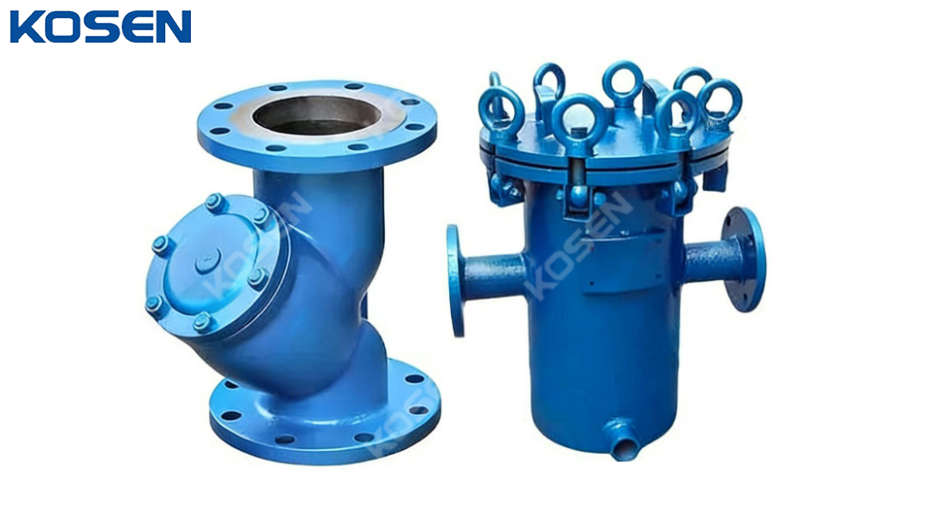
The Y-strainer and basket strainer are two of the most widely used configurations in industrial piping. Both use a removable screen to retain solid particles, but their body geometry and screening arrangements differ considerably.
The main structural differences can be summarized as follows:
| Comparison | Y-Strainer | Basket Strainer |
|---|---|---|
| Body configuration | Compact Y-shaped body | Larger cylindrical or pot-shaped body |
| Screening element | Angled cylindrical screen | Removable basket |
| Filtration area | Generally smaller | Generally larger |
| Dirt-holding capacity | Relatively limited | Relatively high |
| Installation space | Compact | Requires more floor and vertical clearance |
| Typical installation | Horizontal or suitable vertical downward-flow lines | Primarily horizontal pipelines |
| Cleaning access | Cap or cover removal; blowdown option | Top-cover removal and basket extraction |
| Typical service | Steam, gas, high-pressure and moderate-flow systems | High-flow liquid and solids-laden systems |
The most important performance difference is the effective screening area. A basket strainer generally provides a larger screen surface than a Y-strainer of comparable nominal pipeline size. This allows it to distribute the incoming flow across a larger area and retain more debris before cleaning becomes necessary.
In systems containing substantial quantities of suspended solids, the basket configuration can therefore provide longer operating intervals between maintenance activities. This is particularly valuable in cooling-water circuits, industrial water systems, and process lines where contaminants enter continuously.
A Y-strainer has a smaller debris-collection chamber and usually less effective screening area. When the fluid contains large quantities of rust, sand, scale, or welding residue, the screen can become obstructed relatively quickly. As contamination accumulates, the available flow area decreases and pressure loss increases.
However, a larger basket does not automatically guarantee better filtration. The actual performance also depends on screen opening size, effective open area, fluid properties, particle characteristics, and the rate at which contaminants enter the system.
Pressure drop is an important consideration when selecting any pipeline strainer. It represents the pressure difference between the inlet and outlet caused by the resistance of the housing and screening element.
When the screen is clean, a basket strainer often produces a lower pressure drop than a comparable Y-strainer because its larger free screening area reduces the average velocity through the openings. This can be particularly beneficial in large-flow liquid systems where minimizing hydraulic resistance helps reduce pumping energy consumption.
A Y-strainer generally has a more compact internal flow path. Depending on its geometry, screen dimensions, and connection size, it may produce a higher pressure drop than a basket strainer under comparable conditions. This difference can become more significant when a fine mesh is installed or when the screen begins to accumulate debris.
Nevertheless, it is inaccurate to assume that every basket strainer has a lower pressure drop than every Y-strainer. Actual performance must be determined using the manufacturer's pressure-drop curves, flow-capacity data, and specified screen configuration.
The condition of the screen is equally important. As retained contaminants accumulate, the effective open area decreases and the pressure drop rises. A strainer that performs efficiently when clean may become a significant restriction if maintenance is delayed.
Y-strainers are widely used in high-pressure applications because their compact pressure-containing bodies can be designed for demanding service conditions. Specialized forged or cast designs are available in high-pressure classes, including applications involving high-pressure steam and industrial process fluids.
Spirax Sarco notes that certain Y-strainers can be designed for pressures as high as 400 bar(g), although such service requires careful consideration of temperature, materials, and pressure-containing design. This figure should not be interpreted as a universal rating for all Y-strainers.
Basket strainers are also available in a range of pressure classes, but conventional large-volume designs are commonly associated with low- and medium-pressure liquid systems. Their larger housings, covers, and sealing arrangements must be engineered to withstand the specified pressure and temperature conditions.
The actual pressure rating of either type depends on several factors:
- Body material and manufacturing method.
- Design pressure and operating temperature.
- Applicable pressure class or PN rating.
- Cover and bolting design.
- Gasket material and sealing arrangement.
- Screen construction and allowable differential pressure.
- Applicable design and inspection requirements.
For example, a carbon steel Y-strainer rated for one pressure class cannot be assumed suitable for a higher-pressure steam line simply because the body configuration is compact. The pressure-temperature rating of the selected material and the manufacturer's certified design data must always be checked.
Maintenance requirements directly affect the total operating cost of a pipeline strainer. Although both types use removable screens, their cleaning procedures and suitability for continuous operation are different.
A conventional Y-strainer is usually cleaned by isolating the pipeline, relieving internal pressure, draining the trapped medium where necessary, and removing the cap or cover. The cylindrical screen can then be extracted, inspected, cleaned, and reinstalled.
This procedure is relatively straightforward, but the compact body can make screen removal and handling less convenient, especially in confined spaces. Depending on the pipeline arrangement and maintenance design, the equipment may need to be shut down before the screen can be removed.
For applications where debris accumulation is expected, a blowdown connection can be installed at the collection chamber. Opening the blowdown valve allows accumulated contaminants to be discharged using the pressure of the process medium, reducing the need to remove the screen for every cleaning operation.
However, blowdown is not a universal substitute for inspection. It may remove loose debris but cannot necessarily eliminate deposits trapped in fine mesh or material adhering to the screen.
A basket strainer is generally easier to service because its cover provides direct access to the removable basket. After the system has been safely isolated and depressurized, the operator can open the cover, lift out the basket, remove accumulated debris, and reinstall the cleaned element.
The larger basket is often easier to inspect and clean than a compact Y-strainer screen. This advantage is particularly useful in applications involving substantial quantities of suspended solids or frequent contamination.
Some basket strainer designs include quick-opening covers, lifting arrangements, or blowdown connections. Larger baskets may require mechanical lifting equipment because the combined weight of the basket and retained debris can become considerable.
For systems that cannot tolerate process interruption, duplex basket strainers provide an additional solution. They contain two screening chambers connected through a switching arrangement. One chamber remains in service while the other is isolated for cleaning, allowing the process to continue operating.
| Maintenance Factor | Y-Strainer | Basket Strainer |
|---|---|---|
| Access to screen | Through cap or cover | Through top cover |
| Screen removal | Usually requires more handling in confined spaces | Generally straightforward |
| Cleaning frequency | Often higher in dirty service | Often lower due to greater holding capacity |
| Blowdown option | Commonly available | Available on selected designs |
| Online cleaning | Possible with suitable blowdown arrangements | Possible with suitable blowdown or duplex arrangements |
| Maintenance clearance | Relatively limited | Requires space above the housing |
| Heavy debris handling | Limited collection volume | Better suited to larger debris loads |
It is important to distinguish between a standard simplex strainer and a duplex strainer. A conventional basket strainer does not automatically allow cleaning without stopping the process. Continuous operation requires an appropriate bypass, duplex configuration, or another engineered cleaning arrangement.
Y-strainers are particularly suitable for applications where compact dimensions, pressure resistance, and protection of individual downstream components are important.
High-pressure industrial pipelines require strainers with pressure-containing bodies, reliable covers, and screens capable of withstanding the expected operating and differential pressures.
Y-strainers are frequently selected for these services because their compact geometry can be engineered for high-pressure applications. They are commonly used in oil and gas facilities, power plants, chemical processing equipment, and high-pressure utility lines.
The selection must consider both the maximum operating pressure and the maximum differential pressure that may occur when the screen becomes blocked. A pressure rating for the body alone does not establish that the screen can withstand every possible blocked-screen condition.
Y-strainers are a common choice for steam pipelines. They help remove rust, pipe scale, welding residue, and other contaminants that could interfere with steam traps, control valves, pressure-reducing valves, and flowmeters.
Their compact structure and availability in high-pressure materials make them suitable for many steam applications. They can also be fitted with blowdown connections to facilitate the removal of accumulated debris.
Installation orientation is particularly important. In horizontal steam or gas lines, the collection pocket is commonly positioned horizontally to avoid creating a pocket in which condensate can accumulate. In liquid service, the pocket is generally directed downward. For vertical pipelines, downward flow is required for conventional Y-strainer installation so that debris can enter and remain in the collection chamber.
These requirements differ according to the fluid and operating arrangement. Engineers should follow the manufacturer's installation instructions rather than assume that every Y-strainer can be installed in any vertical direction.
Y-strainers are frequently installed immediately upstream of equipment that is sensitive to solid contamination.
Examples include:
- Control valves that may be affected by particles trapped around the trim.
- Steam traps that can become obstructed by rust and scale.
- Flowmeters that require relatively clean flow passages.
- Pressure regulators and reducing valves.
- Small pumps and other compact mechanical equipment.
Their relatively small footprint makes them convenient for installation close to the equipment being protected, provided adequate access is available for cleaning and inspection.
Y-strainers can be designed for gases and selected corrosive liquids. However, suitability depends on the body, screen, gasket, and bolting materials, as well as the chemical and physical properties of the medium.
For corrosive service, stainless steel screens and compatible body materials may be required. In more demanding chemical applications, specialized alloys or protective linings may be considered.
For gas service, engineers must also evaluate gas density, flow velocity, pressure loss, and the possibility of liquid accumulation. A design suitable for water service cannot simply be transferred to a gas pipeline without hydraulic verification.
Basket strainers are particularly attractive for systems requiring high flow capacity, substantial debris retention, and convenient access to the screening element.
One of the most common applications is the protection of pumps against solid contaminants.
A basket strainer installed upstream of a pump can capture debris before it enters the impeller or internal clearances. Its relatively large screening area can help reduce pressure loss and extend cleaning intervals in systems with moderate or heavy contamination.
For pump suction applications, however, the strainer must be sized carefully. Excessive pressure loss can reduce the pressure available at the pump inlet and increase the risk of cavitation.
Engineers should therefore evaluate the available net positive suction head (NPSHa) and compare it with the pump's required net positive suction head (NPSHr), allowing for the additional pressure loss that may develop as the basket becomes dirty.
A strainer should not be selected solely because its nominal size matches the pump suction line. Its effective free area and pressure-drop characteristics are equally important.
Cooling-water systems often contain rust, sediment, biological debris, and particles introduced through open cooling towers, reservoirs, or water intake structures.
Because these contaminants may enter the system continuously, a strainer with a large dirt-holding capacity can reduce cleaning frequency and improve operational stability.
Basket strainers are commonly used in industrial cooling-water circuits, heat-exchanger inlet lines, condenser systems, and circulating-water pipelines. For particularly heavy solids loading or very large water flows, engineers may also consider automatic self-cleaning strainers or specialized intake screens.
Large-volume liquid systems benefit from the relatively large screening area of basket strainers. Compared with a compact Y-strainer of similar nominal pipe size, a properly sized basket design can provide a larger effective flow area and lower clean-screen pressure loss.
This makes basket strainers suitable for water treatment, industrial process circulation, fuel handling, and other applications where maintaining flow capacity is important.
In large pipelines, the basket housing may be significantly heavier than a Y-strainer. Foundation support, lifting clearance, cover-removal space, and maintenance access should therefore be included in the equipment layout.
Basket strainers can also be used in applications involving viscous liquids, such as certain oils, resins, coatings, and chemical products.
A larger screening area can help distribute the flow and reduce the velocity through the screen openings. This is beneficial because viscous fluids generally produce greater hydraulic resistance than low-viscosity liquids.
Nevertheless, the effect of viscosity must be included in the pressure-drop calculation. Sticky or adhesive contaminants may also accumulate on the screen and require more intensive cleaning. Depending on the process, a basket strainer with a suitable screen design, heating arrangement, or specialized cleaning system may be necessary.
Choosing between a Y-strainer and a basket strainer requires a systematic evaluation of process conditions. The following factors should be considered before issuing a technical specification or purchasing order.
The first step is to establish the design pressure, normal operating pressure, maximum operating temperature, and any abnormal conditions that may occur during startup or shutdown.
For high-pressure steam or process lines, a suitably rated Y-strainer is often a practical choice. For large-volume, low- or medium-pressure liquid systems, a basket strainer may provide better hydraulic and maintenance performance.
However, the configuration alone does not determine pressure suitability. The selected model must have a documented pressure-temperature rating that satisfies the project requirements.
Flow rate directly affects the velocity through the screen and the pressure loss across the strainer.
A small strainer installed in a large-flow system may produce excessive pressure drop, even if its nominal pipeline connection appears compatible. Conversely, an unnecessarily oversized unit may increase capital cost, installation space, and maintenance complexity.
The design should therefore be based on the actual operating flow range, including minimum, normal, and maximum flow conditions.
For high-flow applications, a basket strainer is often advantageous because its larger effective screening area can reduce the velocity through the element.
The nature of the solids is just as important as the total quantity.
Typical contaminants include:
| Contaminant | Common Source | Selection Consideration |
|---|---|---|
| Rust and pipe scale | Aging pipelines | Screen opening and cleaning frequency |
| Welding slag | Pipeline fabrication and installation | Robust screen construction |
| Sand and sediment | Raw water and process fluids | Dirt-holding capacity |
| Fibres and plant debris | Open water systems | Basket geometry and cleaning access |
| Fine particles | Process contamination | Mesh selection and pressure loss |
| Sticky deposits | Oils, resins, and chemical products | Screen accessibility and cleaning method |
A Y-strainer may be sufficient when contamination is relatively light and intermittent. A basket strainer is generally more suitable when the system contains substantial quantities of debris or requires longer intervals between manual cleaning.
If the solids loading is extremely high, neither conventional design may provide an economical long-term solution. Automatic self-cleaning filters, duplex strainers, or dedicated filtration systems should then be evaluated.
The screen opening determines the approximate size of the particles that can be retained. It should be selected according to the protection requirements of the downstream equipment.
Two common screening arrangements are used:
Perforated metal screens: These are made from metal sheets with punched openings. They are relatively robust and are often used for general pipeline debris removal.
Wire mesh screens: These provide smaller openings and can capture finer particles. They are commonly supported by a perforated backing screen to improve mechanical strength.
Mesh count refers to the number of openings per linear inch. A higher mesh count generally indicates smaller openings, but the actual opening size also depends on wire diameter and mesh construction.
It is therefore important not to specify mesh count alone. Procurement documents should identify the required opening size in millimetres or microns, together with the screen construction and material.
An excessively fine screen may create a rapid increase in pressure drop and may become blocked more frequently. The goal is not to achieve the smallest possible opening, but to provide sufficient protection without imposing unnecessary hydraulic resistance.
The effective open area is the total area available for fluid to pass through the screen openings. It is different from the gross geometric area of the screen.
A larger effective open area generally reduces the velocity through the openings and helps control pressure loss. It also provides more available capacity for debris accumulation before the screen becomes significantly restricted.
For preliminary design, engineers sometimes compare the screen's effective free area with the pipeline's internal cross-sectional area. However, no single area ratio is suitable for every application. The required ratio depends on flow rate, fluid properties, screen opening, solids loading, and allowable pressure drop.
Manufacturers' technical guides provide model-specific open-area ratios and pressure-drop information. These data should be used in the final selection.
A strainer should be evaluated in both clean and contaminated conditions.
The clean-screen pressure drop indicates the initial hydraulic resistance. The dirty-screen pressure drop shows how the system may perform as debris accumulates.
For liquid service, the pressure loss is affected by flow rate, fluid density, viscosity, screen geometry, and the degree of blockage. For steam and gas service, compressibility and operating pressure must also be considered.
Where manufacturer capacity data are available, the pressure-drop calculation should follow the manufacturer's published method. A generic estimate should not replace certified performance curves for critical applications.
Differential-pressure gauges or transmitters can be installed across the strainer to monitor the pressure difference between its inlet and outlet. A rising differential pressure provides an indication that the screen is becoming obstructed and requires inspection or cleaning.
The physical dimensions of the strainer can affect the overall piping layout.
A Y-strainer is generally preferred where installation space is limited or where the pipeline passes through a congested equipment area. Its compact body can simplify integration into existing piping systems.
A basket strainer requires more room, particularly above the housing, because the basket must be lifted out for cleaning. For large units, engineers should also consider the weight of the basket, lifting equipment, access platforms, and the space required to remove the cover.
Maintenance access should be considered during the design stage rather than after installation. A strainer that is difficult to open or clean may result in longer shutdowns and higher operating costs.
If the process can be stopped periodically for maintenance, a standard simplex strainer may be sufficient.
If the process must operate continuously, the maintenance arrangement becomes a major selection factor. Options include:
- A Y-strainer with a suitable blowdown arrangement.
- A basket strainer with a designed blowdown connection.
- A duplex basket strainer with two switchable chambers.
- An automatic self-cleaning strainer for high or continuous solids loading.
The correct solution depends on the required operating continuity, contaminant characteristics, and acceptable maintenance intervention.
The body and screening element must be compatible with the process medium and operating conditions. Material selection affects mechanical strength, corrosion resistance, temperature capability, and service life.
| Material | Typical Characteristics | Common Applications |
|---|---|---|
| Cast iron | Economical, suitable for selected low-pressure services | General water and utility systems |
| Ductile iron | Higher strength and toughness than conventional grey cast iron | Water distribution and industrial utilities |
| Carbon steel | Good mechanical strength and broad industrial availability | Oil, gas, steam, and process pipelines |
| Stainless steel 304 | General corrosion resistance | Water and selected non-aggressive media |
| Stainless steel 316/316L | Improved resistance to many chloride-containing and chemical environments compared with 304 | Chemical, marine, and corrosive services |
| Alloy steel | Suitable grades can provide high-temperature strength | High-temperature steam and power applications |
The material must be selected based on actual chemical composition, concentration, temperature, pressure, and corrosion mechanisms. For example, stainless steel 316 is not universally resistant to all chloride environments, particularly under conditions that promote pitting or stress corrosion cracking.
The screening element is commonly manufactured from stainless steel because it provides a useful combination of strength, corrosion resistance, and availability.
Typical options include:
- Stainless steel 304 for general-purpose applications.
- Stainless steel 316 or 316L for more demanding corrosion environments.
- Specialized nickel alloys for selected aggressive chemical services.
- Other compatible alloys where high temperature or special process conditions require them.
The screen must also have sufficient mechanical strength to withstand the expected differential pressure. A very fine mesh may require a perforated support layer to prevent deformation or collapse.
The applicable design and inspection requirements depend on the strainer's construction, pressure rating, connection type, and project specification.
Commonly referenced standards include:
- ASME B16.34: Pressure-temperature ratings, materials, dimensions, and other requirements for applicable valve designs. It may be relevant to certain strainer products when specified by the manufacturer, but it should not automatically be treated as a universal strainer standard.
- ASME B16.5: Flanged end dimensions and pressure classes for applicable pipe flanges and flanged fittings.
- ASME B31.3: Process piping design requirements in applicable chemical and industrial facilities.
- ASME B31.1: Power piping requirements for relevant power-generation and industrial systems.
- EN 1092-1: Steel flange dimensions and pressure designations for applicable European piping systems.
Buyers should confirm which standards apply to the complete strainer assembly, including its body, connections, pressure-containing components, and inspection documentation.
For demanding services, the purchase specification may also require material certificates, pressure testing records, dimensional inspection, welding documentation where applicable, and traceability of pressure-containing materials.
Even when the correct general configuration is chosen, several specification and installation errors can reduce reliability.
Matching the strainer's nominal size to the pipeline does not guarantee adequate capacity. The actual flow rate, effective screening area, and pressure drop must also be checked.
A nominally compatible unit may still create excessive resistance if its screen is too small or too fine for the process conditions.
The differential pressure across the screen increases as contaminants accumulate. If the screen becomes severely blocked, the resulting load may deform or damage the screening element.
The body pressure rating and screen differential-pressure capability are separate considerations. Both should be verified.
A very fine mesh may appear to offer better protection, but it can also cause frequent blockage and high pressure loss. The opening should be selected according to the actual particle size that needs to be retained and the tolerance of the downstream equipment.
Incorrect orientation can prevent contaminants from collecting properly and may create unwanted liquid pockets in gas or steam service.
For example, conventional Y-strainers in vertical pipelines generally require downward flow. Horizontal steam service also has specific pocket-orientation considerations to reduce condensate accumulation.
A basket strainer may offer excellent filtration capacity, but its cover cannot be opened effectively if there is insufficient overhead clearance. Similarly, a Y-strainer may be difficult to service if its cap faces an inaccessible wall or structural component.
Maintenance space should be included in the piping layout.
A conventional pipeline strainer is generally designed to capture coarse debris. If the process requires very fine particle removal, a dedicated filter or a staged filtration arrangement may be necessary.
Using a conventional strainer beyond its intended filtration duty may lead to repeated blockage and inadequate process protection.
There is no universally superior option. The correct choice depends on the operating conditions and the priorities of the piping system.
| Application Requirement | Recommended Starting Point | Reason |
|---|---|---|
| High-pressure service | Y-strainer | Compact pressure-containing design is widely available in high-pressure configurations |
| Steam pipeline protection | Y-strainer | Commonly used upstream of steam traps and control valves |
| Limited installation space | Y-strainer | Compact body and smaller footprint |
| High-flow liquid service | Basket strainer | Larger effective screening area |
| Heavy solids loading | Basket strainer | Greater dirt-holding capacity |
| Pump suction protection | Basket strainer | Can provide lower clean-screen pressure loss when correctly sized |
| High-viscosity liquid | Basket strainer | Larger screening area can reduce hydraulic resistance |
| Frequent manual cleaning | Basket strainer | Removable basket provides convenient access |
| Continuous operation | Duplex or specially configured strainer | Allows one chamber to remain in service while another is cleaned |
A useful way to approach the decision is to identify the most critical operating constraint.
If pressure resistance, compact installation, or steam service is the dominant consideration, a Y-strainer is often the more practical starting point. If the system handles large volumes of liquid containing substantial debris, a basket strainer is generally worth evaluating first.
Where both high pressure and heavy solids loading are present, neither configuration should be selected automatically. A specially engineered strainer, a larger screening arrangement, or a duplex system may be more appropriate.
Y-strainers and basket strainers are both essential components for protecting industrial pipelines and downstream equipment, but they are designed around different operating priorities. A Y-strainer offers compact construction, broad availability in high-pressure designs, and suitability for many steam and moderate-flow applications. A basket strainer provides a larger screening area, greater dirt-holding capacity, and convenient screen removal, making it particularly suitable for high-flow liquid systems and services with heavier contamination.
For reliable selection, engineers should evaluate operating pressure and temperature, flow rate, contaminant concentration, screen opening, effective open area, clean and dirty pressure drop, material compatibility, and maintenance requirements. By considering these factors together—and checking the manufacturer's technical data rather than relying on general assumptions—plant operators and project engineers can improve equipment protection, reduce unnecessary pressure losses, and achieve more reliable long-term pipeline operation.