Key Factors in Cryogenic Ball Valve Material Selection
In industrial fields, cryogenic ball valves, as an important control device, are widely used in liquefied natural gas, petrochemicals, refrigeration, and other industries. Their core function is to precisely control the flow of fluids under low-temperature conditions. However, low-temperature environments impose extremely stringent requirements on the materials of ball valves. This article will delve into the key factors in selecting materials for cryogenic ball valves, helping you better understand and apply this knowledge.
In low-temperature environments, material performance changes significantly. Apart from materials with face-centered cubic crystal structures such as austenitic steel, copper, and aluminum, ordinary steels will exhibit low-temperature brittleness. This brittleness reduces the valve’s strength and service life, and may even lead to sudden fracture of the valve under low-temperature conditions, causing serious safety accidents. Therefore, selecting materials suitable for low-temperature operation is the primary task in the design of cryogenic ball valves.
Aluminum does not exhibit low-temperature brittleness, which gives it certain application potential in cryogenic valves. However, the hardness of aluminum and aluminum alloys is relatively low, and the wear resistance and scratch resistance of sealing surfaces are poor. Therefore, aluminum is mainly applied in low-pressure and small-diameter cryogenic valves. In these scenarios, the advantage of aluminum lies in its light weight and good low-temperature toughness, which can meet basic operational requirements.
For alloy steels, carbon and chromium steels rapidly lose impact strength below -20°C. Therefore, their usage temperatures are limited to -30°C and -50°C, respectively. In contrast, nickel steel with 3.5% Ni can be used down to -100°C, and nickel steel with 9% Ni can be used down to -192°C. This indicates that nickel steel performs better under low-temperature conditions and can effectively resist low-temperature brittleness.
Austenitic stainless steels, nickel, Monel alloys, Hastelloy, titanium, aluminum alloys, and bronze can be used at even lower temperatures (-273°C). These materials are widely applied in cryogenic ball valves due to their excellent low-temperature performance. Particularly, austenitic stainless steels, such as 304 and 316L, are preferred for valve bodies because of their good low-temperature toughness and corrosion resistance.
- Low-Temperature Impact Strength: Valve internals must possess sufficient cold impact strength to prevent fracture in low-temperature environments. Low-temperature impact strength is an important indicator of a material’s ability to withstand impact loads under low-temperature conditions. For example, during the transport of liquefied natural gas and other low-temperature media, valves may experience sudden pressure changes and shocks, making the material’s low-temperature impact strength especially important.
- Mechanical Properties: In addition to low-temperature impact strength, materials must maintain certain mechanical properties at low temperatures, such as relative elongation and microstructural stability. Relative elongation reflects the material’s plastic deformation ability under low temperatures, while microstructural stability ensures that the material does not undergo microscopic structural changes during long-term low-temperature use, thereby maintaining performance stability.
- Thermophysical Properties: Thermophysical properties, such as thermal conductivity and cold contraction, are also important considerations in selecting cryogenic valve materials. Good thermal conductivity ensures that the valve quickly reaches thermal equilibrium in low-temperature environments, reducing the impact of temperature gradients on valve performance. Cold contraction must be compatible with the valve’s structural design to avoid stress concentration and deformation caused by temperature changes.
- Wear and Corrosion Resistance: Under low-temperature and oil-free conditions, valve components need good wear resistance to reduce friction-induced wear. Materials also require excellent corrosion resistance to withstand chemical erosion from low-temperature media. For example, in liquefied natural gas environments, materials must resist corrosion from trace moisture and impurities in the gas.
- Weldability: If welded connections are used, the weldability of the material must also be considered. During welding, the joints must have low-temperature performance similar to the base material to ensure the welded area does not become a weak point. For example, austenitic stainless steel requires appropriate heat treatment after welding to restore low-temperature toughness.
In the design and manufacturing of cryogenic ball valves, the selection of main component materials is crucial, directly determining the performance and reliability of the valve in low-temperature environments. The following principles should be followed when selecting main component materials to ensure safe and stable operation of cryogenic ball valves under extreme low temperatures.
When the operating temperature is above -100°C, ferritic steel is the preferred material. Ferritic steel has good low-temperature toughness and machinability, meeting the operational requirements of most cryogenic valves in this temperature range. Valve stems and bolts are usually made of Ni or Cr-Mo alloy steels and undergo appropriate heat treatment to improve tensile strength and prevent thread galling.
When the operating temperature is below -100°C, austenitic steel becomes the main choice. Austenitic steels such as 304 and 316L are widely used in cryogenic ball valves due to their excellent low-temperature performance and corrosion resistance. However, 18-8 acid-resistant steel has low hardness, which can cause friction between the stem and packing, resulting in leakage. Therefore, stem surfaces are usually treated with hard chrome plating, nitriding, or nickel-phosphorus plating to increase surface hardness.
For low-pressure and small-diameter cryogenic valves, copper and aluminum materials can also be considered. These materials perform well at low temperatures and have relatively low processing costs. However, selection should be based on comprehensive evaluation of specific operating conditions and temperature requirements.
After discussing the principles for selecting main component materials for cryogenic ball valves, we now focus on another critical area: the selection of packing and sealing materials.
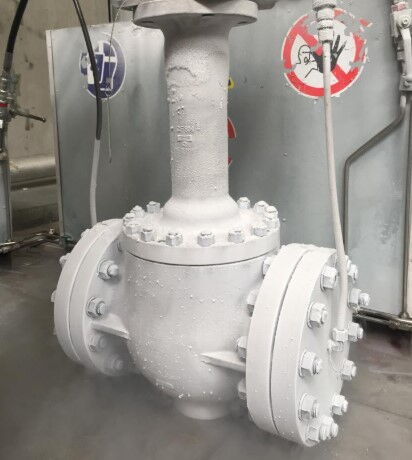
As temperatures decrease, fluoroplastics shrink significantly, which reduces sealing performance and easily causes leakage. Asbestos packing cannot avoid permeation leakage. Rubber becomes brittle at low temperatures and swells with media such as liquefied natural gas, making it unsuitable for cryogenic valves. In cryogenic valve design, packing must work near ambient temperature through structural design, for example, using long-neck bonnets to keep the packing chamber away from low-temperature media. Additionally, packing materials must be chosen for their low-temperature characteristics. PTFE-impregnated asbestos packing is a common choice. Flexible graphite is a recently developed excellent sealing material; it is impermeable to gases and liquids, has 10–15% elasticity in thickness, and achieves good sealing with relatively low tightening pressure. Furthermore, flexible graphite has self-lubricating properties, preventing wear between packing and stem. Flexible graphite packing operates in the temperature range of -200 to 870°C, meeting the requirements of most cryogenic valves.
Sealing material selection is equally important. For conditions requiring high wear resistance and corrosion resistance, stainless steel combined with hard alloys can be used. For conditions requiring excellent sealing performance, soft sealing materials such as reinforced PTFE, PCTFE, or PEEK are suitable. Metal sealing materials like Invar or specialized steels can effectively compensate for thermal expansion due to ultra-low thermal expansion coefficients (1.6×10^-6/°C), thereby improving sealing performance.
All cryogenic material components must undergo deep cryogenic treatment before finishing. Deep cryogenic treatment reduces contraction and deformation in low-temperature service and improves dimensional stability. In material processing, solution treatment temperature and cooling rate must be strictly controlled to prevent σ-phase precipitation and embrittlement. For precipitation-hardened stainless steels (such as 17-4PH), over-aging (e.g., H1150 state) can significantly improve low-temperature toughness, ensuring reliability and safety under cryogenic conditions.
Practical case studies can further deepen understanding of material performance and application. They visually demonstrate how material selection affects performance and reliability of cryogenic ball valves, and how optimization can be performed according to specific industrial requirements.
In the LNG industry, cryogenic ball valves need to operate stably for long periods at extremely low temperatures (around -162°C). Typically, the valve body uses 304 or 316L stainless steel for excellent low-temperature toughness and corrosion resistance. The ball surface is overlaid with Stellite alloy to improve wear and corrosion resistance. Seats use reinforced PTFE or Invar to ensure good sealing performance and thermal compensation. The stem uses 17-4PH stainless steel with hard chrome plating to enhance surface hardness and wear resistance. Packing uses flexible graphite to ensure sealing and self-lubrication at low temperatures.
In the refrigeration industry, the working temperature of cryogenic ball valves is usually between -40°C and -80°C. Valve bodies and bonnets can be made of ferritic or austenitic steel, depending on the minimum operating temperature. Seats use PCTFE to meet sealing requirements. Stems are 304 stainless steel with nitriding treatment for improved wear and corrosion resistance. Packing uses PTFE-impregnated asbestos to ensure low-temperature sealing performance.
Material selection for cryogenic ball valves is a complex and critical process, requiring comprehensive consideration of low-temperature performance, mechanical properties, thermophysical properties, wear resistance, corrosion resistance, and weldability. Through proper material selection and optimized processing, the performance and reliability of cryogenic ball valves can be significantly enhanced, meeting the strict requirements of low-temperature control devices across various industrial fields. In practice, detailed design and material evaluation must be conducted according to specific operating conditions and temperature requirements to ensure safe and stable operation of cryogenic ball valves in low-temperature environments.